How to match your next move to your current Human-First AI Marketing skill level
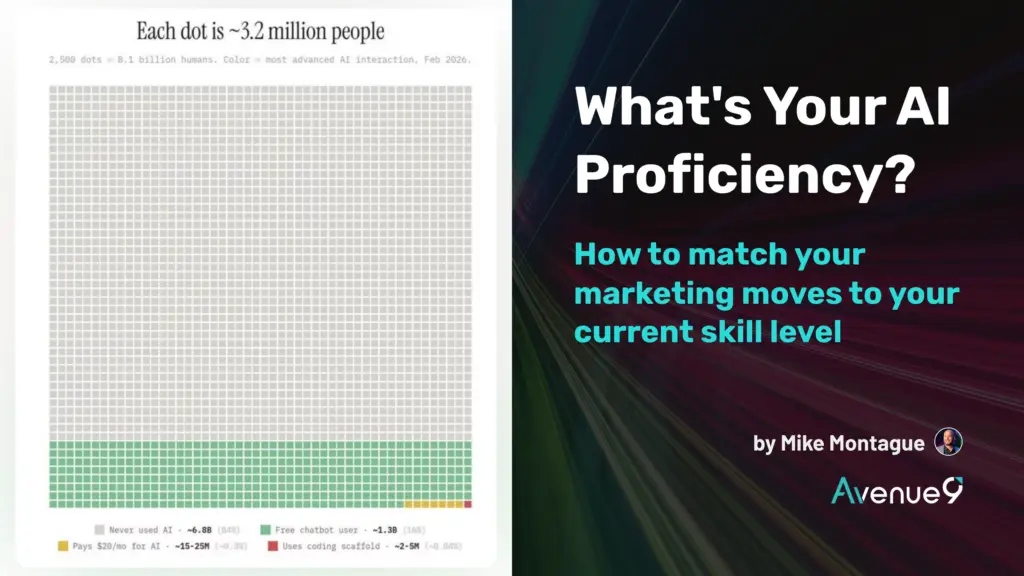
The good news is that you are not behind. On the planet, most people have never used AI. The large portion of those who have use some sort of free version baked into other tools. A small fraction actually pay for an AI tool they use regularly, and a tiny minority can actually use it to program something better than just using an LLM for generative AI.
It is still very early in the AI adoption curve.
Where you are in your AI journey determines what you need to focus on right now.
Someone who’s never cooked doesn’t need a better knife. Someone who’s never driven doesn’t need a sports car. And someone who’s never used AI for marketing doesn’t need a 47-step automation workflow on day one.
So here’s the question that actually matters… When you think about everything that is possible with AI, from generative and video to predictive analytics and machine learning to AEO and automation, where are you?
On a scale of 1 to 10, where is your AI proficiency right now?
Your answer changes everything about how you should approach Human-First AI Marketing®.
I’ll use your number to point you toward the work that actually moves the needle. There are three phases of the journey, and each one requires something completely different.
Levels 1–3: Do the Mindset Work
If you’re here, you either haven’t started yet, you’ve started and stopped, or you’re convinced AI is going to take your job, or it’s just a fancier Google to search and ask questions.
All three of those positions are worth examining, because they’re all partially true and mostly incomplete.
Here’s the honest truth at this level: no AI tool in the world will help you, yet. The problem is your relationship with the idea of AI itself.
The work at levels 1–3 looks like this:
- Examine your beliefs. Where did they come from? A headline? A fear? A bad experience with a customer service chatbot that couldn’t tell you their own store hours?
- Look for evidence. Find one real example of a business like yours using AI and winning. Then find another one. Let proof replace assumption.
- Lower the stakes. Play with AI the way you’d try on a new outfit. No audience, no pressure, just curiosity.
- Reframe the relationship. AI is a very fast, very literal assistant who needs your brain to do anything meaningful. You’re still in control. You still get to decide if you use the results or not
The goal here isn’t to become an AI expert. The goal is to get comfortable enough to try something new. Confidence at this level comes from experiencing the tools and what they can do.
Levels 4–7: Do the Strategy Work
You’ve played with AI. You’ve probably used it to write a few emails or brainstorm some ideas. Maybe you’ve had a few small wins that made you think, “Okay, there’s actually something here.”
Now you’re standing at the edge of something bigger, and the temptation is to collect more tools. Resist that impulse.
At this level, the bottleneck is strategy, habits, and process. You don’t need a new app. You need a plan for the apps you already have.
The work at levels 4–7 looks like this:
- Build a real AI marketing strategy. Know where you want AI to play, where you want humans to lead, and what “good” looks like when the two work together.
- Audit your habits. Which repetitive tasks are you still doing manually that AI could handle with a solid prompt and a clear workflow?
- Create decision frameworks. When should you publish AI-assisted content with a human pass? When does AI stay out of the conversation entirely?
- Think in systems. The best AI-powered marketers are better process thinkers. Build one piece of quality content and ask yourself: how many ways can I repurpose this?
This is where the A9^Factor becomes your best asset. It’s a nine-part marketing system built to give growing businesses the structure to move from sporadic and reactive to strategic and scalable. It gives your AI efforts somewhere purposeful to land.
The goal at this level is consistency over cleverness. A repeatable process beats a brilliant one-off hack every time.
Levels 8–10: Do the Technical Mastery Work
You’ve got the mindset. You’ve built the strategy. AI is now woven into how your business operates daily. That’s genuinely rare, and it’s worth acknowledging. Congrats!
Over-reliance is the trap that catches almost everyone at this level.
When you’re good at something, it starts to feel like the answer to everything. A polished AI workflow can make every marketing challenge feel like it’s one prompt away from being solved. It isn’t. Just as a surgeon who knows only one procedure will plateau, an AI-dependent marketer will eventually hit a wall that better prompts can’t overcome.
The work at levels 8–10 looks like this:
- Go narrow on tools. You don’t need more AI options. You need to master fewer of them at a deeper level. Know the shortcuts, the edge cases, and the failure modes.
- Test advanced techniques. Context engineering, custom instructions, structured output, multi-step reasoning chains. These aren’t exotic. They’re just the difference between a good AI result and a great one.
- Watch your dependency. Are there decisions you’re outsourcing to AI that belong to you? Are you still writing at least one unassisted piece a week? Keep that muscle warm. AI tools can make you dumber if you consistently outsource your thinking.
- Teach someone. The surest sign of mastery is the ability to explain it simply. If you can’t walk a level-5 through the process that makes you a level-9, you don’t fully own it yet.
At this level, AI proficiency training isn’t something you need. It’s something you help build for your team.
One More Thing About this AI Proficiency Scale
Your number isn’t fixed, and it isn’t universal.
You might be an 8 at using AI for content and a 3 at using it for data analysis. You might be a 7 strategically but a 4 operationally because your team hasn’t caught up to where your thinking is. That’s a real and common gap.
Use the scale as a diagnostic, not a judgment. Pick the area where your number is lowest and go do the work that level requires. That’s where you can grow the most.
The marketers winning with AI right now aren’t the ones with the most tools. They’re the ones who know exactly where they are, exactly what they need, and exactly where to focus next.
That’s the whole marketing game in the first place. It always has been and always will be.
Your Next Move
If you’re a 1–3: spend the next 30 days exploring. Read one article, watch one demo, try one thing. Build a relationship with the idea before you build a system around it.
If you’re a 4–7: block two hours this week to audit your current AI use and write down three repeatable processes you want to build around it. Strategy first, tools second.
If you’re an 8–10: pick one AI tool you use daily and go one level deeper into how it actually works. Then turn around and teach it to someone else.
And if you want a structured path to move up the scale faster, that’s exactly what we built at Avenue9. Let’s start the conversation.