Everybody’s Talking About Generative AI. They’re Missing the Bigger Opportunity.
Most AI conversations today remind me of the early days of the internet. Back then, everybody was obsessed with websites. Companies spent fortunes debating fonts, colors, and homepage designs. Meanwhile, the real opportunity wasn’t the website itself. It was everything the internet would eventually make possible.
I think we’re in a similar moment with AI.
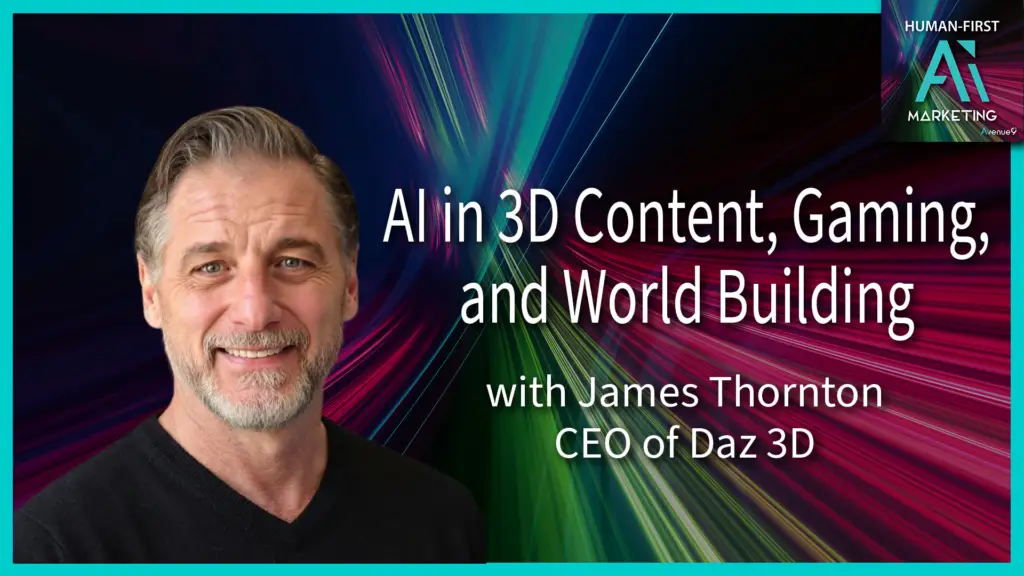
Right now, most business owners are focused on content generation. They’re asking ChatGPT to write blogs, create emails, summarize meetings, and generate social posts. That’s useful. We do it every day. But after a recent conversation with James Thornton, CEO of Daz 3D, I came away convinced that we’re still looking at a relatively small piece of what’s happening.
James works at the intersection of 3D content creation, AI training data, gaming, digital avatars, and virtual world building. If you’re a marketing director at a manufacturing company or an SMB owner trying to grow revenue, that might sound pretty far removed from your day-to-day reality.
I thought so too.
Then we started talking about robots opening doors.
The Future of AI Has Hands
One comment from James completely changed the way I was thinking about AI.
He explained that if you took one of the best robots in the world today, walked it up to your front door, and asked it to reach for the handle and open the door, it would still miss the handle three or four times out of ten. Think about that for a second. A machine can summarize a legal document, write a marketing plan, generate software code, and answer trivia questions faster than any human alive. Yet there’s still a good chance it can’t get into your house.
The reason is surprisingly simple.
Language is not the same thing as understanding the physical world.
Most of today’s AI models have been trained on text, images, videos, and information pulled from the internet. That’s incredibly powerful if you’re trying to predict words, recognize patterns, or generate content. It doesn’t teach a robot how to grip a doorknob, balance a package, or pick up a dropped screwdriver.
Those tasks require an understanding of movement, physics, pressure, depth, dexterity, and space. According to James, that’s where structured 3D training data becomes essential. You can’t just scrape a bunch of photos from Google and expect a robot to learn how a hand works. The training data has to be intentionally modeled, structured, and designed for those use cases.
The more I thought about it, the more I realized this isn’t just a robotics story.
The businesses getting the best results from AI aren’t necessarily feeding it more information. They’re feeding it better information. The same principle applies whether you’re teaching a robot how to grab a door handle or teaching ChatGPT how to represent your brand. Quality inputs produce quality outputs.
That’s one of the reasons we’ve spent so much time at Avenue9 talking about Context Engineering. Generic prompts produce generic answers. Rich context produces useful ones.
Why Gaming Is Suddenly a Business Conversation
One thing I appreciated about James was that he didn’t try to oversell futuristic concepts. He talked about what companies are actually doing today.
Historically, much of Daz 3D’s work has been tied to gaming, entertainment, and content creation. Those industries needed realistic characters, environments, and 3D assets. What surprised me was hearing how quickly the conversation is shifting toward physical AI and robotics. James said that over the last couple of months, some of the fastest-growing interest has moved beyond gaming and into real-world AI applications.
That’s where I think a lot of business leaders are missing the plot.
Most people hear “gaming” and mentally file it under entertainment.
What James described is infrastructure.
The same technologies used to create realistic game environments are now being used to train AI systems. The same 3D models used for virtual worlds can be used for robotics training, simulations, digital twins, and machine learning applications.
That’s a much bigger story than gaming.
James shared an example where a real-world video clip, such as a traffic accident, can be recreated in a 3D environment. Once it’s modeled, thousands of variations can be generated. The weather can change. The lighting can change. The objects can change. The environment can change. Suddenly one real-world event becomes a massive training dataset.
That’s a fascinating idea because it highlights where AI is heading next.
We’re moving from machines that understand information toward machines that understand environments.
Why Digital Identity Matters More Than Most Brands Realize
Another part of the conversation that stuck with me had nothing to do with robots.
It had to do with people.
James shared that many of the world’s largest brands are actively exploring digital doubles, avatar influencers, and virtual identities because younger audiences increasingly view their digital identity as an extension of their real-world identity.
I think marketers should pay close attention to that.
Not because everybody needs a virtual influencer next quarter. Not because the metaverse is suddenly back. But because customer behavior is changing.
If someone spends several hours a day on YouTube, TikTok, Discord, Roblox, Fortnite, or whatever platform comes next, that digital environment becomes part of how they experience brands, communities, and culture.
James mentioned projects involving iconic brands, celebrity likenesses, and digital avatars designed to connect with younger audiences. The interesting part wasn’t the technology. The interesting part was the strategy behind it. Brands are looking for ways to stay relevant in environments where traditional advertising becomes less effective.
Marketers have been solving that problem for decades. The channels change. The principle stays the same. Meet people where they are.
The Uncanny Valley Is Really a Trust Problem
One of the reasons I wanted to have James on the podcast in the first place was because I suspected we’d agree on something.
We did. AI-generated humans are still weird.
Marketers have a term for this called the uncanny valley. When something looks almost human but not quite human, our brains pick up on it immediately. It’s unsettling.
James acknowledged that directly. He explained that when creating digital influencers and avatars, AI still needs human touch. There still needs to be creative control because the technology isn’t quite there yet.
I think that’s an important lesson beyond avatars.
It’s a lesson about trust.
Every week I see people trying to automate their entire marketing strategy. Automated content. Automated outreach. Automated comments. Automated direct messages. Automated everything.
The result usually feels exactly like those uncanny valley avatars.
Close. But not quite right. People can feel it.
That’s why our Human-First AI Marketing® philosophy continues to resonate with clients. The goal isn’t to remove humans from the process. The goal is to capture human expertise, human stories, human insights, and then use AI to help distribute them more effectively.
Authenticity still matters.
The tools have changed. Human psychology hasn’t.
What Business Leaders Should Actually Do About This
Whenever I have conversations like this, I try to translate them into practical actions.
I don’t think the takeaway is that every SMB should hire a 3D artist. I don’t think every manufacturer needs a robot. I definitely don’t think every brand needs an avatar influencer.
The lesson is simpler than that.
Pay attention to where the technology is heading, not just where it is today.
Most business owners are still evaluating AI based on how many hours it saves or how many blog posts it can generate. Those are reasonable questions. They’re just not the only questions worth asking.
The more interesting question is what becomes possible when these technologies mature.
What happens when AI understands physical environments? What happens when digital identities become commonplace? What happens when customers interact with brands through immersive experiences instead of static websites?
Nobody knows exactly how those questions get answered. But I know this much. The businesses that consistently outperform their competitors are usually paying attention before the opportunity becomes obvious.
That’s why I enjoyed this conversation with James so much. It wasn’t another discussion about prompts, productivity hacks, or the latest AI tool. It was a glimpse at what might be coming next. And from where I’m sitting, the next chapter of AI looks a lot more three-dimensional than most people realize.
Want to Build a Human-First AI Marketing Strategy?
At Avenue9, we help business owners capture the expertise that’s already inside their organization and turn it into scalable marketing assets. Through our Human-First AI Marketing® approach, we use interviews, customer stories, thought leadership, and AI-powered distribution to help businesses build trust, visibility, and authority in both search engines and answer engines.
If you’re ready to create marketing that feels more human while becoming more scalable, let’s talk.