
Hyper-Targeting Beats More Marketing
If you are an SMB owner or marketing director, there is a good chance you have been pitched the same AI fantasy for the last two years: wire together a few agents, automate everything, and enjoy passive revenue while you sleep. Nice dream. Bad plan.
If you are an SMB owner or marketing director, there is a good chance you have been pitched the same AI fantasy for the last two years: wire together a few agents, automate everything, and enjoy passive revenue while you sleep. Nice dream. Bad plan.
One of the biggest takeaways from my conversation with Dan Baird from Wrench AI is that AI is not a cheat code; it is a moving target. The novelty fades fast. The trick everybody copies stops being a trick. The shortcut becomes a traffic jam. Dan said it plainly: what worked a year ago already looks cute, and what works now will keep changing. That matters because a lot of businesses are still looking for one magic workflow instead of building the skill to adapt faster than the market.
That is why I keep coming back to a human-first approach to AI marketing. Do the hard human part first. Know your audience. Know what they care about. Know what signals actually matter. Then use AI to scale the execution, not replace the thinking. That was one of the clearest themes in this interview, and it is the difference between teams that get better results and teams that just make more mediocre content faster.
Better marketing starts with better listening
Dan’s background in sales and product research shows up all over this conversation. He talked about learning early that the best salespeople ask the most questions because they are the best listeners. They do the research. They understand how people make decisions. They do not just show up with an elevator pitch and hope it lands.
That idea should hit home for every business owner and marketing leader right now. Most AI-generated marketing fails for the same reason bad cold outreach has always failed: it is centered on what the seller wants to say, not what the buyer needs to hear. Dan made the point that the elevator pitch is often just a polished version of your own internal talking points. Your audience does not care about your talking points. They care about their problem, their priorities, their risk, their time, and whether you sound like you understand them.
So before you ask AI to write the email, ad, landing page, or LinkedIn post, pause and do the grown-up work. Who is this for? What kind of buyer are they? What stage are they in? What are they skeptical about? What proof do they need? If you do not know that, the tool is not your bottleneck. You are.
Generic AI content is the new generic marketing
Another lesson from the interview: personalization is not the same thing as swapping in a first name and company name. Dan made a sharp distinction between AI that can personalize to you and AI that can adapt to your audience. That is a massive gap, and most businesses are still falling into it.
This is where hyper-personalization gets interesting. Not creepy-personal. Not “I saw you went to Olympus High” personal. Just competent. The kind of personalization that says: I know what kind of buyer you are, I know how you process information, and I know what kind of message will reduce friction for you. Dan talked about using personality signals, behavioral cues, and category language to shape the message. Some buyers want social proof. Some want data. Some want the fast version. Some want every receipt in the folder. Same offer; different packaging.
That is not fluff. Mike and Dan discussed campaigns where personality-based messaging dramatically improved results, with reported gains ranging from meaningful lifts to eye-popping increases in appointment setting. Dan also said it is not uncommon to see outsized returns when this kind of targeting and message matching is done well.
For SMBs, this is the good news. You do not need Super Bowl budgets to do smarter segmentation anymore. You need a better hypothesis, cleaner inputs, and the willingness to stop sending the same vanilla message to everyone.
Bigger, fewer, better
This might have been my favorite line in the whole interview: bigger, fewer, better. Dan’s argument is simple and brutal. You do not need to spray a million people and hope 1% bites. You can improve that 1% by yourself if you get more precise about who you target and how you talk to them.
That idea is gold for SMB owners and midmarket marketers because it replaces ego metrics with economics. More impressions is not a strategy. More emails sent is not a strategy. More content published is definitely not a strategy. Better-fit prospects, better conversations, and better conversions; that is a strategy.
When you focus on fewer, better-fit prospects, several good things happen at once. Your message gets sharper because it is written for someone real. Your sales process gets easier because the lead quality improves. Your content gets more useful because it speaks to actual buying questions. Your wasted spend drops because you are not paying to interrupt people who were never a fit anyway. Dan framed that as compound interest, and I think that is exactly right. Small gains in fit and relevance stack up fast.
If you cannot prove it, it is probably branding theater
There was another valuable thread in this episode that deserves more attention: AI can produce polished nonsense very quickly. Dan warned that large language models often sound smart while making things up, and he argued that marketers need more than pretty outputs. They need the logic, the tables, the scoring model, and the numbers underneath the answer.
That is a big deal for owners and marketing directors because we are entering the phase of AI adoption where “can it generate something?” is no longer the interesting question. The interesting question is “can I trust it, measure it, and tie it to revenue?” Dan’s answer was to anchor the flashy output in real data structures such as lead scoring, machine learning models, and reliable inputs that the system can reference instead of invent.
In plain English: do not let the robot do math in the dark and then clap because the sentence sounded confident.
This is also why smaller businesses have an edge right now. You can build cleaner systems faster. You can test faster. You can connect the dots between campaign, lead quality, appointment rate, and revenue without six departments and a sacrificial spreadsheet. Big companies still have brand muscle and budget. They also have meetings. Lots of meetings. SMBs and midmarket firms can be much more dangerous if they combine focus with the right tools. Dan and Mike both made the case that the current market favors nimble teams that can move, experiment, and iterate without dragging a parade float behind them.
Authenticity is still undefeated
This part matters more than most people realize. Dan talked about working with huge brands and seeing firsthand how much money gets spent trying to manufacture authenticity. Celebrities, giant campaigns, massive production budgets, all of it. Then he contrasted that with the natural advantage smaller companies still have: real founder energy, real conviction, real point of view, real closeness to the customer.
You cannot fake that very well. At least not for long.
That is why I think the Avenue9 approach works so well for SMBs. Your founder stories matter. Your customer stories matter. Your best salesperson’s language matters. Your unique method matters. AI can amplify those things beautifully. It just cannot invent them with the same force. If you hand AI mush, you get faster mush. If you hand it sharp ideas, strong stories, and a clear audience, you get leverage.
This also connects to one of the most practical lines in the interview: people will punish you if you do not do your homework. Buyers today expect that you know the obvious stuff about them before you reach out. Not private stuff; public stuff. If your outbound message makes it clear you did not even glance at their website, LinkedIn, podcast, or product, you are already underwater. Relevance is no longer a bonus. It is table stakes.
Relationships will beat reach
When Mike asked Dan what wins over the next three to five years, Dan’s answer was relationships. Not scale. Not spam. Not just better automation. Relationships. That stood out because it sounds almost old-fashioned until you hear the logic behind it. If the cost of content goes to zero, and the cost of synthetic conversation keeps dropping too, then attention gets more selective. Trust gets more valuable. Relevance gets more valuable. Being “the answer for the right person” becomes the whole game.
That is exactly where I think a lot of marketing is headed. More agent-to-agent filtering. More noise. More content than any human could ever consume. Which means your job is not to publish more stuff into the void. Your job is to be the right fit, with the right point of view, for the right audience, at the right moment.
That is why hyper-targeting matters. Not because it sounds futuristic, but because it is respectful. It respects the buyer’s time. It respects your budget. It respects the fact that the best growth usually comes from resonance, not interruption.
What SMB owners and marketing directors should do next
Here is the practical takeaway from all of this: stop trying to “use AI” in general. Start using it to make specific parts of your marketing smarter.
Use it to clarify who your best-fit buyers are. Use it to segment by pains, priorities, and buying style. Use it to test different message angles for different audiences. Use it to turn founder insights and customer stories into targeted campaigns. Use it to score leads and prioritize outreach. Use it to help you decide what content is worth making in the first place. That last one might be the most important. As Mike said near the end of the episode, when execution gets easier, the content questions get more interesting: what should we make, why should we make it, and who is it for?
That is the real opportunity here.
Not more content. Better bets.
Not more automation. Better decisions.
Not more marketing. Better fit.
Questions people ask
Why is “automate everything and earn while you sleep” a bad plan?
Dan Baird of Wrench AI put it plainly: AI is a moving target, not a cheat code. The trick everybody copies stops working, the shortcut becomes a traffic jam, and what worked a year ago already looks cute.
What beats doing more marketing?
Hyper-targeting. Fewer, better messages to precisely the right people, informed by real data and context, outperform volume every time. It is the Context Circles idea applied to campaigns: the right story, right person, right time.
How should an SMB use AI for targeting without being creepy?
Use AI to understand and prioritize, then let humans decide what to say and how. Relevance earns attention; surveillance-style personalization burns it. Human-First AI Marketing® keeps the buyer’s trust ahead of the tactic.
More on Podcast
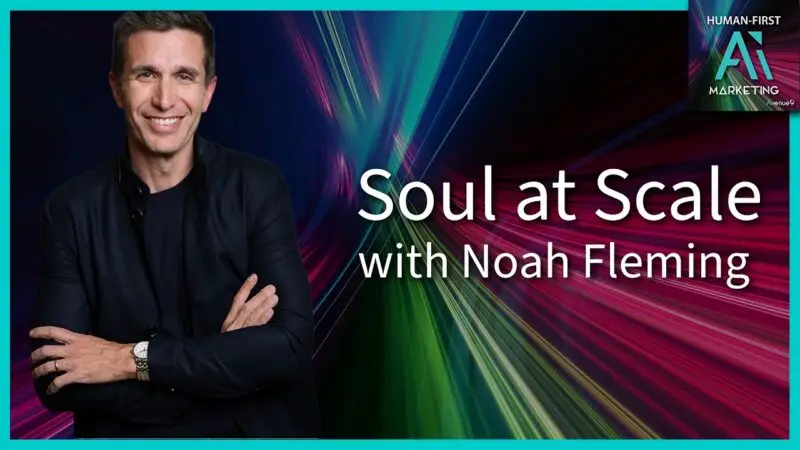
Soul at Scale with Noah Fleming
How can businesses scale with AI while preserving meaningful customer relationships? Mike Montague talks with Soul at Scale author Noah Fleming about…
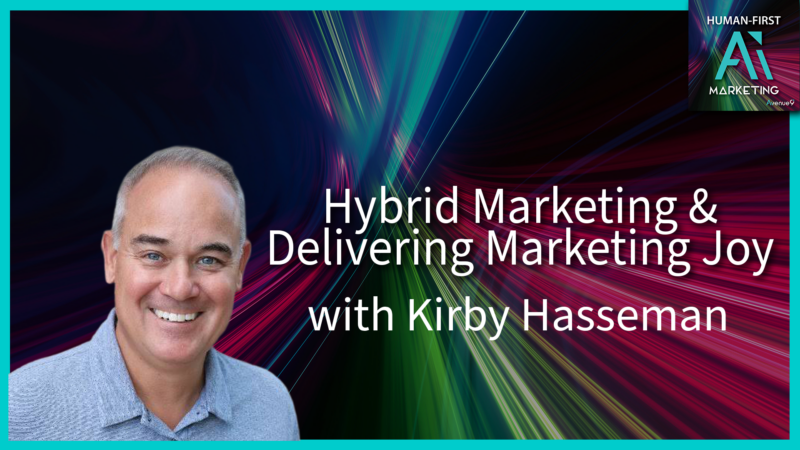
Hybrid Marketing & Delivering Marketing Joy with Kirby Hasseman
Kirby Hasseman joins Mike Montague to explore hybrid marketing, promotional products, and why combining digital reach with memorable human experiences can help…