The AI Marketing Strategy That Defines Your Culture and Your Results
The world’s greatest sci-fi writers accidentally gave us the two most useful frameworks in modern marketing strategy.
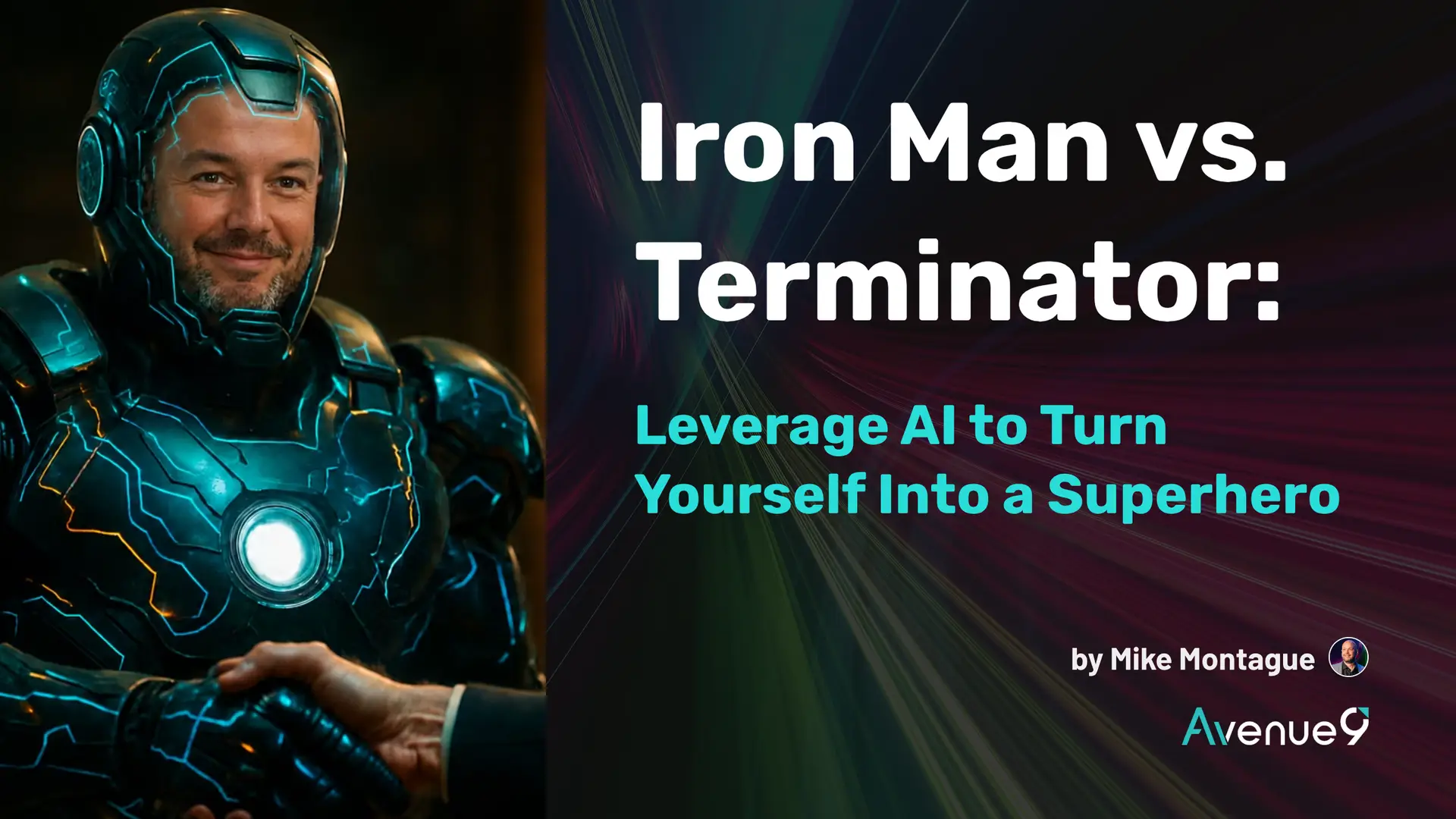
Iron Man is a human who uses AI and robotics to become a superhero. The Terminator tries to imitate being a human while it destroys humanity. And right now, every business owner with an AI subscription is choosing between these same two strategies, sometimes without realizing it.
If you are not as big a sci-fi nerd as I am, let’s dig into this a bit further.
The Terminator strategy is about developing autonomous AI agents. You give it a mission, and it executes at all costs. No judgment calls. No empathy. Just mission, execution, repeat. A lot of businesses look at the promise of AI and see exactly this strategy: “We’ll make money while we sleep.” “I’ll get my time back.” or “Agents will do the busy work and free you up for higher-level tasks.” That logic is understandable. It’s also quietly destroying trust with every automated pitch-slap that lands in someone’s inbox. That’s automation.
Iron Man works differently. Tony Stark is a genius, a strategist, and more than a little charismatic. He doesn’t outsource the mission to the suit. He wears it to give him capabilities he wouldn’t have on his own. JARVIS, his AI, feeds him information he wouldn’t have otherwise. The suit handles speed, power, and precision. Tony handles direction, judgment, and the decisions that matter. Together, as Iron Man, the human and AI accomplish things neither could do alone. That’s amplification.
Avenue9 and our Human-First AI Marketing® strategy is built on the Iron Man model.
The Terminator Strategy Looks Good on Paper
Let’s be honest… The Terminator path is genuinely seductive. For a time-starved SMB owner, it sounds like rescue. The agents will come and do the hard parts of the job you don’t like. You can replace expensive, time-consuming, and complicated human workers with AI agents that will just do whatever you tell them to do, and do it tirelessly every time.
AI agents are becoming more powerful every month. The Age of Intelligent Entities is here, and the companies chasing full automation are racing to the bottom; they’re just following the loudest voices in the market. I get it, the hype cycle around agentic AI is real, and it promises efficiency gains that no reasonable person would turn down.
The problem is what happens on the other end of all that automation, you know, with your clients, employees, and prospects. Your prospects get bombarded with millions of generic emails, LinkedIn connection requests with a templated message, and “just checking in” follow-ups that sound like they were written by the same sales AI robot. Because it was.
It doesn’t scale if everyone in your industry has access to the same AI tools and agents. By the time your name appears in front of a real human, you’ve already burned your credibility.
Efficiency without intention is just faster noise. And the data is pretty clear on what happens when businesses automate before they’ve built a human-first foundation: more content, fewer results, and a brand voice that sounds like it was generated by a committee of robots who attended the same marketing seminar.
The Terminator doesn’t know when to stop. That’s kind of the whole problem with both the movie and the marketing strategy. It’s time for you to decide to stop this approach.
The Iron Man strategy works because the human is involved throughout the process.
Tony sets the strategy. The suit makes it possible. JARVIS accelerates it.
That’s the mental model worth carrying into every AI marketing decision you make. The technology handles the heavy lifting. You handle the direction, the relationships, and the moments that require actual judgment. At Avenue9, we call it Human-First AI Marketing, but it is actually human first, last, and all throughout the middle.
In practice, you might come up with a cool idea, have AI flesh it out and draft the content, then edit it in your own voice and send it to a real customer. You might let AI analyze your audience data while you decide what story to tell. You might automate a repetitive customer success onboarding sequence so you have more capacity for the irreplaceable hand-holding.
The goal isn’t less human involvement. It’s better human involvement, applied where it matters most.
I created the Human+AI Capability Map™ to help business owners and marketing leaders make exactly this decision explicitly, not by gut feel. The map divides your work into four zones based on what your team can do and what AI can do. Most of the work that matters, the creative, the relational, the strategic, sits in what I call the Iron Man zone: the space where humans and AI collaborate to produce something neither could accomplish alone. That’s where speed and quality rise together.
The A9^Factor builds on this same principle. Nine levers, each one designed to amplify human judgment and creativity rather than replace it. When you pull the right levers, AI doesn’t water down your marketing. It concentrates it.
The framework has three pillars:
- Human-First Strategy – Audience Clarity, Authentic Brand Voice, and Unique Offer.
- AI Marketing Systems – Channel Mapping, Conversion Architecture, and Content Engine.
- Scalable Storytelling – Sales Stories, Trust Signals, and Context Circles.
Together, they create a practical path for using AI to build trust, increase visibility, and grow without losing your voice.
AI is an amplifier that multiplies your intent.
If your intent is to help, teach, clarify, and build trust, AI can help you do that at scale.
If your intent is to interrupt, manipulate, chase, and convert at any cost, AI can help you do that, too.
The machine is not moral. It is a multiplier.
The Accidental Terminator
Here’s the thing nobody tells you… Most businesses don’t choose the Terminator path on purpose. They slide into it slowly at first, then quickly as they are swept up in the landslide.
A client of mine was building an AI system to conduct outbound sales calls. The pitch was compelling… Consistent messaging, infinite availability, no bad days. On paper, it looked like a competitive advantage.
In practice, it was quickly pissing people off, destroying trust, and burning through their list faster than they could add to it.
I helped them pivot to an Iron Man approach. We used the same AI avatar technology, but with a completely different philosophy. Instead of replacing the salesperson, we used the AI to role-play the buyer. The reps could practice objection handling, test new positioning, and sharpen their pitch in a low-stakes environment, then show up to real calls better prepared, more confident, and more human.
The AI didn’t take or make the calls. It made the person taking the call significantly better at their job.
Same AI. Opposite outcome. One builds capability in humans. The other erodes it…
By default, AI will make you dumber, weaken your communication skills, and destroy trust with your buyers.
If you’ve already been running Terminator-style automation, the good news is the suit is still available. You can redirect. The human-first path isn’t about abandoning AI; it’s about deciding how to use it within reason and context and in the best interest of you, your employees, and your clients.
The Iron Man Zone
The most valuable real estate in your marketing operation isn’t your CRM, your ad budget, or your content calendar. It’s the space in your calendar where you use your human judgment.
It’s where you, as the leader, pair the right people with the right tools and the right processes. The output is something genuinely better than either AI or humans could produce alone. Real collaboration, innovation, and amplification, where the human sets the intent, AI accelerates the execution, and the result still remains personal.
The A9^Factor is a framework that gives you nine levers that multiply marketing impact by keeping humans at the center of the strategy while AI handles everything it’s actually good at: research, pattern recognition, drafting, repurposing, and scale. When those levers are pulled in the right order, marketing compounds rather than just accumulates.
Every time you consider using AI in your marketing, run it through this test.
- Will this help us understand our audience better?
- Will this protect or strengthen our authentic voice?
- Will this make our offer clearer?
- Will this help us show up in the right channels with more relevance?
- Will this improve the buyer’s journey?
- Will this make our content more useful, specific, and trustworthy?
- Will this help our sales team tell better stories?
- Will this create stronger trust signals?
- Will this deliver the right message to the right person in the right context?
Those nine questions map directly to the A9^Factor.
The difference between automation and amplification is the difference between agentic advertising, which erodes trust, and marketing that builds it.
Your Business Doesn’t Need a Robot. It Needs a Superhero.
AI is the most powerful amplifier in the history of marketing. Feed it a clear strategy, an authentic voice, and real human context, and it will help you reach farther and work faster than any small business team could have imagined five years ago.
Feed it a mission and walk away, and you’ll get what the Terminator always delivers: relentless action, completely devoid of emotion.
Every marketer reading this is already choosing between these two paths. Some are choosing deliberately. Some are letting the tools choose for them.
Tony Stark is one of the most beloved superheroes of all time. The Terminator was defeated by mere humans and was forced to evolve its strategy.
What would it look like for your business to take a human-first Iron Man approach?