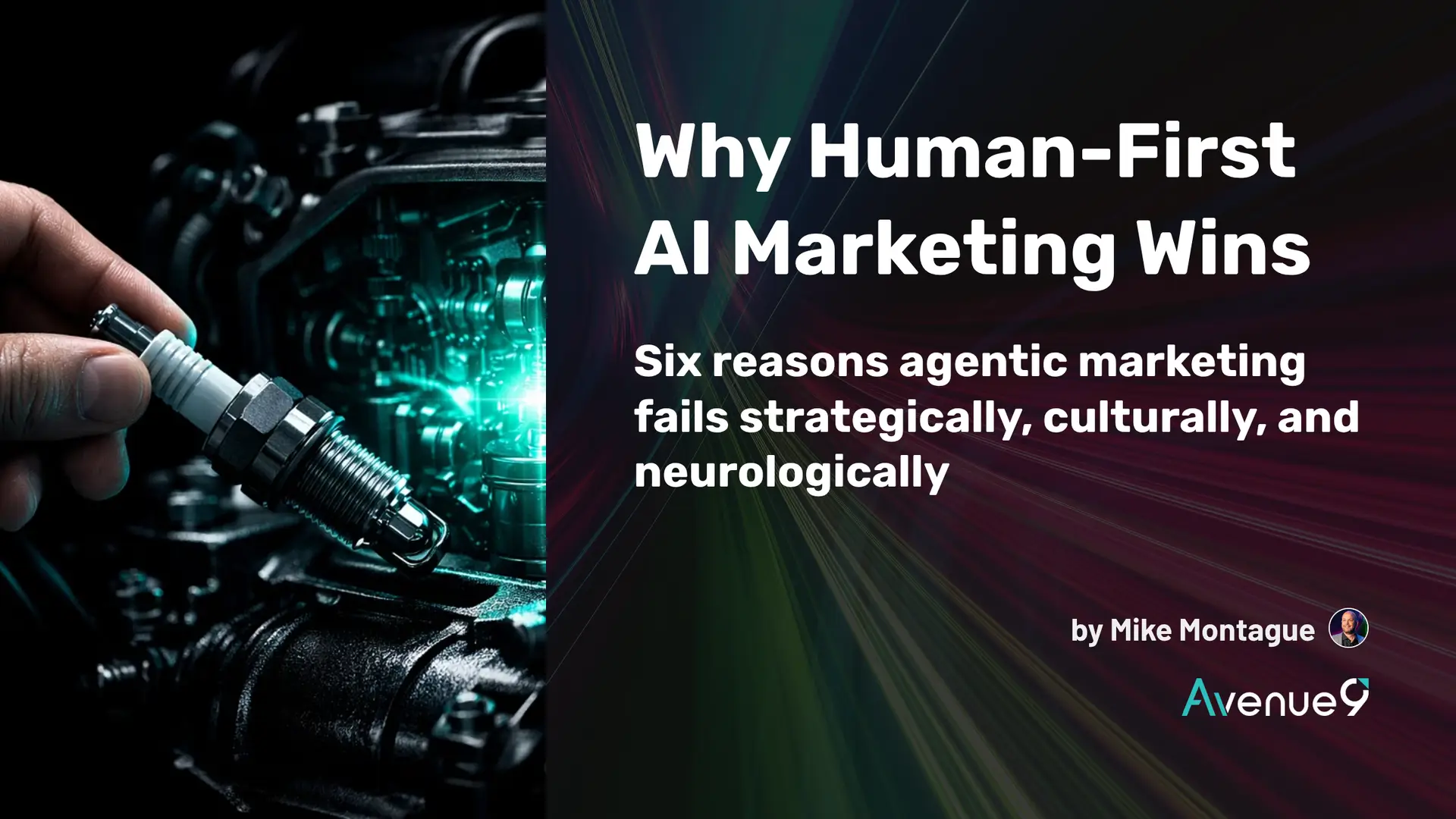
Six reasons why agentic marketing fails strategically, culturally, and neurologically
The relentless hype around AI-driven agentic marketing is fool’s gold.
After 15 months of research, interviewing over 75 AI and marketing experts, and retaining 100% of our clients while adding over 100% growth in 2025, here’s why Human-First AI Marketing outperforms AI-first automation.
Over the last year, I have watched otherwise smart teams automate more outreach, publish more, and respond faster, and launch customer service chatbots… All while quietly losing confidence, connection, clarity, capability, and credibility. The promise of an agentic future in lead generation is already broken.
The companies winning with AI so far are those that preserve human thinking and feeling. Humans set direction first. Humans make connections with prospects and clients first. Humans have a conversation first. Humans set the marketing strategy first.
Humans work best as the sparkplug that starts the revenue engine. AI works best as a contained explosion within the engine, creating tremendous leverage and increasing momentum.
With a Human-First AI Marketing system, performance compounds. When AI accelerates execution before direction is set, you get speed, but not leverage. Motion but not progress. You get too much drift and slop from the AI output.
If you are a CEO navigating AI marketing decisions right now, remember:
AI is phenomenal at execution. Humans are irreplaceable at direction.
When you reverse that order, performance suffers dramatically, and your revenue engine stalls quickly.
Here are the six lessons every SMB leader needs to understand before scaling AI any further.
1. Thinking Is an Important Part of the Process
There is a dangerous assumption baked into modern AI workflows. That receiving an answer is the same as having an idea.
It is not.
Think about it now. Would you rather hire Ken Jennings, who knew every answer on Jeopardy, or someone who printed off all of his answers after the show aired?
Real thinking happens through struggle. Through trying to articulate something that is not yet clear. Through conversations that force you to name what you actually believe.
Psychology and neuroscience agree on this point. When people generate ideas themselves, neural connections form. When they consume answers passively, those circuits barely engage.
When teams start with AI instead of thinking:
- Strategy meetings become quieter.
- Decisions get faster but thinner.
- Confidence erodes because no one owns the thinking.
AI can tell a story, but it doesn’t have one itself, and it doesn’t have enough context to write the next chapter of yours unless you do the thinking first.
Make human articulation non-negotiable. Require teams to outline their thinking before using AI. The friction is not inefficiency. It is where clarity is born.
You are not just protecting creativity. You are protecting the machinery of thought. AI-first workflows shortcut the very process that makes people smart, confident, and capable.
2. Convenience Has a Cost
One of the least discussed risks of AI is skill atrophy.
When tools do the work for us, our brain and body stop maintaining the muscles responsible for those skills. This is not metaphorical. It is physical.
Think about when humans stopped working in the field and started working at desks. We had to go to the gym to maintain our weight and muscles. The same thing is happening right now with our brains.
Studies show that:
- People lose spatial reasoning when they rely on GPS.
- Doctors lose diagnostic skill when AI does the seeing for them.
- Knowledge workers collapse when assistive tools are removed.
Over-automation creates fragile teams. Everything works until the tool fails, the context shifts, or judgment is required. Then performance drops fast.
What will happen years from now when you have failed to train the next generation of salespeople and marketers?
AI literacy is not about teaching tools. It is about teaching restraint. Human-First AI protects the skills that make teams valuable in the first place.
Use AI where 90 percent accuracy is acceptable. Keep humans in the loop where judgment, nuance, and trust matter. AI should reduce fatigue and burnout from repetitive work, but not replace creativity or capability.
3. AI Can Produce Output Without Ownership
AI-generated work often looks impressive. Grammatically clean, structurally sound, professionally formatted, and yet, something feels off.
That feeling is a symptom of the damage being done to your credibility, connection, and trust with your prospects and clients.
Trust requires ownership. You cannot own what you did not think through. AI-first content fails the trust test before it ever reaches an audience.
Even worse, when your people skip the process of forming ideas themselves, they cannot explain what they produced, defend it, or evolve it. The work may be correct, but it is hollow. It’s like the difference between the empty calories of a sugary soda and making a homemade glass of fresh-squeezed orange juice.
- Sales teams cannot explain marketing messages.
- Leaders cannot stand behind strategy documents.
- Content feels interchangeable with competitors.
Ownership comes from doing the work, putting in the effort. Require your teams to create the initial draft of ideas, but not the final content draft. AI can help shape and scale. It should not replace authorship. Authority in the marketplace comes from original thought.
4. AI Narrows Thinking Over Time
This one matters more than most leaders realize. When everyone uses the same models, trained on the same data, prompted in similar ways, ideas begin to cluster. Language converges, and originality declines.
This is a marketing problem. Entire industries start to sound the same, differentiation fades, and buyers disengage from caring about your business. Automation is a race to the bottom.
Protect original thought as a strategic asset. Your lived experience, customer conversations, and point of view are the raw material AI cannot invent. Feed the machine with what only your organization knows. If you feed it sameness, you scale sameness.
5. Humans Create Direction, and AI Creates Momentum
This is the most practical distinction leaders can make. Humans excel at divergent thinking:
- Choosing what matters.
- Asking better questions.
- Finding starting points.
AI excels at convergent thinking. Refining, executing, and distilling down massive datasets into usable insights.
When put into your marketing strategy, the order matters more than the tool. AI-first workflows move quickly in the wrong direction. Human-first workflows move intentionally and then accelerate.
Strategy is the destination you enter into the GPS and the mode of transportation you choose. AI can help you get there faster. Reversing that order leads to faster movement in the wrong direction.
6. In a World of Free Answers, Questions Become the Asset
AI is driving the cost of answers toward zero. That does not make leadership easier. It makes it harder.
When answers are abundant, the scarce skill becomes knowing which questions are worth asking. Finding the question is the work.
The most valuable marketing leaders were never the fastest typists. They are the clearest thinkers. They ask better questions, frame better problems, and guide the strategy with intention.
In a zero-cost answer economy, leadership, creativity, and trust are defined by the quality of questions you can ask and the courage to wrestle with them.
Reward clarity, connection, and quality over volume. Treat questions and conversations as intellectual property, not as prompts to produce an AI output.
Get your AI Trust Score for Free!
Human-First AI Marketing is not about resisting technology.
It is about using it in the right order. Humans for ideation and direction. AI for execution and amplification.
The companies that win in the AI era will continue to be those that value thinking, protect judgment, and scale what actually matters: their conversations with customers.
True leadership belongs to those who can ask the right questions.
And that remains, thankfully, a human advantage.
If AI stopped working tomorrow, which parts of your marketing engine would still function, and which skills have you quietly let atrophy?