The AI Gold Rush Feels Familiar
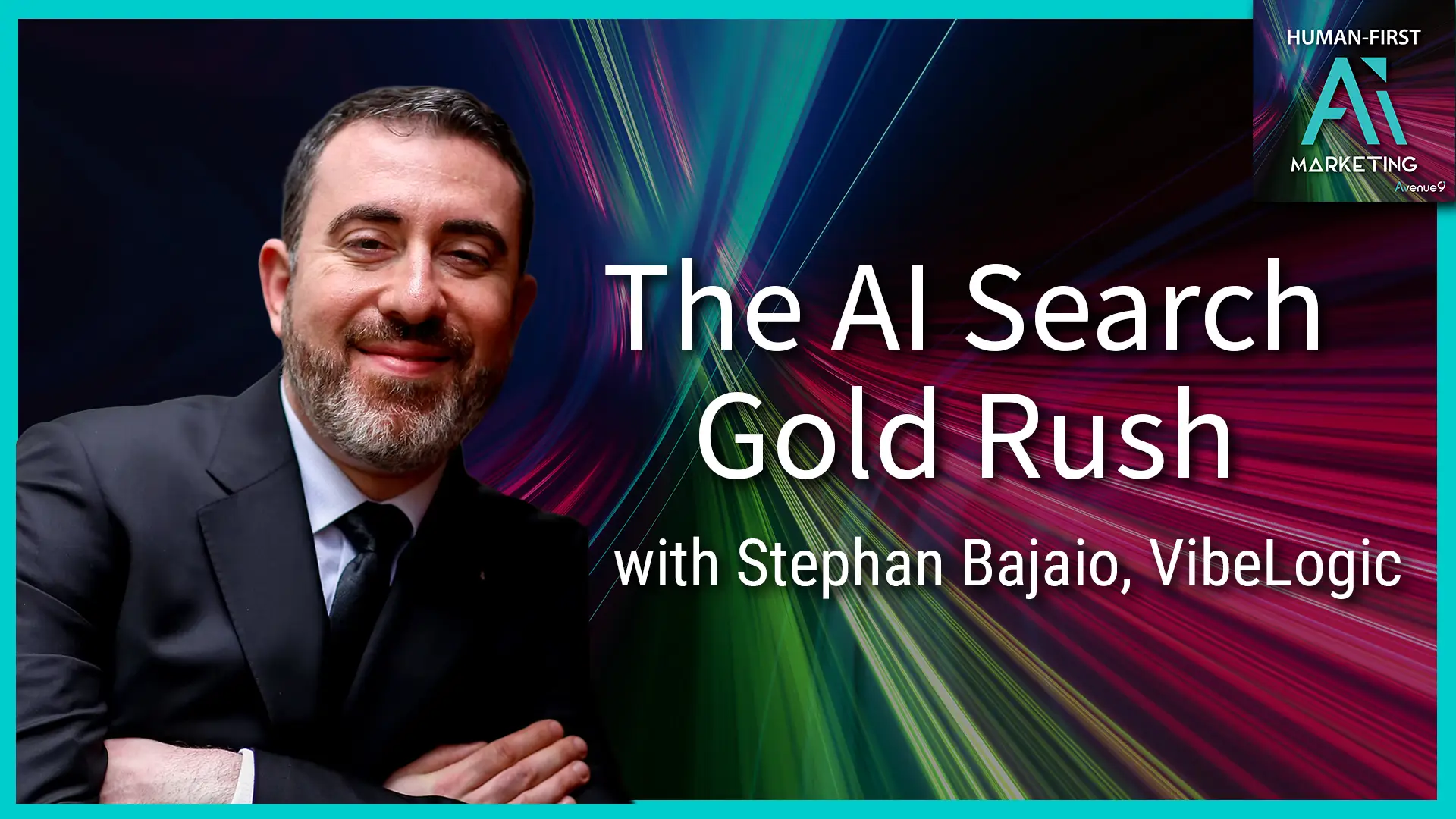
On a recent episode of the Human-First AI Marketing Podcast, Stephan Bajaio of VibeLogic, started telling a story about being a college intern during the dot-com boom.
Back then, companies were pouring money into websites because everyone knew the internet was going to be important. Nobody knew exactly how it was going to work, but they knew they needed to be part of it. Stephan was billing hours on train rides into New York while businesses raced to secure their place in a digital future that hadn’t fully arrived yet. Valuations were exploding. New companies were appearing overnight. Smart people were making predictions that turned out to be wildly wrong. Everybody felt pressure to move faster because nobody wanted to be the one left behind.
If any of that sounds familiar, it’s because we’re watching the same movie again.
The technology is different, but the emotions are identical. Every day somebody asks me how to rank in ChatGPT, how to get cited in AI search, how to optimize for answer engines, or how to make sure their company shows up when someone asks an AI tool a question. Those aren’t bad questions. They’re just usually not the first questions that need answering.
The first question is whether you’ve earned the right to show up in the first place. That’s what made Stephan’s gold rush comparison so interesting.
During the California Gold Rush, most people didn’t get rich digging for gold. Thousands of people packed up their lives, chased rumors, and spent years searching for something they never found. The people who built lasting businesses were often the ones selling the picks, shovels, supplies, and services that miners needed. They focused less on chasing the next discovery and more on solving real problems for real people.
That’s the part that feels relevant right now.
A lot of businesses are approaching AI like prospectors. They’re looking for the trick, the hack, the shortcut that will make them show up first in every AI-generated answer. They’re treating visibility as if it’s the gold itself. Meanwhile, they’re overlooking the fundamentals that actually create value: understanding customers, documenting expertise, and building trust.
Those aren’t nearly as exciting as a new AI ranking strategy.
They’re also the things that tend to survive long after the gold rush ends.
Visibility Has Never Been the Hard Part
That might sound harsh, but hear me out.
A lot of businesses are treating AI visibility like a shortcut. If they can just crack the code, find the right prompt, add the right schema, or hire the right consultant, they’ll somehow leapfrog competitors and land in front of more customers. The problem is that visibility has never been the hard part. Visibility is easy to buy. You can buy ads. You can buy impressions. You can buy clicks. The difficult part has always been becoming useful.
That’s where Stephan and I found ourselves agreeing over and over again.
The businesses that benefit most from AI aren’t necessarily the businesses talking about AI all day. They’re the businesses that understand their customers deeply and are finally getting better tools to share that understanding. AI didn’t suddenly create expertise. It created a faster way to capture, organize, and distribute expertise that already existed.
Your Best Marketing Asset Is Already Inside Your Business
Think about how much knowledge is trapped inside your business right now.
Your best salesperson knows exactly what prospects are worried about before they buy. Your technicians know the mistakes customers make before calling for help. Your founder probably answers the same five questions every week. Your customer service team knows the frustrations, fears, and objections that never make it into your marketing copy. Most companies are sitting on years of valuable insight that never gets documented anywhere.
Then those same companies wonder why AI doesn’t know who they are.
How could it?
You haven’t taught the internet what you know yet.
One of my favorite moments from the conversation came when Stephan started talking about content. Not content as a marketing deliverable. Content as proof of experience. We’ve reached a point where anyone can generate a thousand words with the push of a button. That doesn’t mean those thousand words are worth reading. In fact, most of the content flooding the internet right now sounds suspiciously similar because it’s all being created from the same pool of public information.
Your experience is different.
The conversation you had with a frustrated customer last Tuesday is different. The lesson you learned after a project failed three years ago is different. The reason you changed your process, improved your service, or stopped offering a certain product is different. That’s the stuff people care about. That’s the stuff customers remember. That’s the stuff AI can’t invent because it happened to you.
Stop Chasing Everest
The irony of the current AI search conversation is that many businesses are focusing on the algorithm before they’ve focused on the expertise. It’s like worrying about how many people will come to your restaurant before deciding what’s on the menu. More traffic doesn’t solve a weak message. More exposure doesn’t create trust. More visibility doesn’t make you more relevant.
Later in the conversation, Stephan shared an analogy about Mount Everest that stuck with me. Everybody wants the photo from the summit. Everybody wants to say they reached the highest peak. What gets ignored is the cost, risk, and likelihood of failure. Meanwhile, there are plenty of other mountains that offer a better experience and a much higher chance of success.
Marketing works the same way.
Too many businesses are chasing the biggest keywords, the broadest audiences, and the most competitive spaces before they’ve established authority in their own backyard. They want national visibility before they’ve become known locally. They want millions of impressions before they’ve earned the trust of hundreds of customers.
That’s usually an expensive way to learn a simple lesson.
What AI Rewards
The businesses that win this next phase of marketing will probably look surprisingly similar to the businesses that won the last one. They’ll know who they serve. They’ll understand the problems those people are trying to solve. They’ll consistently share what they’ve learned. They’ll use AI to make that process easier, faster, and more scalable, but the value will still come from the humans involved.
That’s why I don’t spend much time worrying about whether AI is replacing search.
I spend a lot more time thinking about whether businesses are documenting their expertise.
Because if you’re doing that well, you’ll be in a pretty good position no matter how people discover information five years from now.
The Real Gold Rush
The gold rush eventually ends. It always does.
The companies that survive aren’t usually the ones that chased every opportunity. They’re the ones that built something useful while everyone else was chasing shiny objects.
After talking with Stephan, that’s where I think the biggest opportunity is right now. Not in trying to outsmart AI. Not in trying to manipulate rankings. Not in finding the latest growth hack.
The opportunity is taking the knowledge, experience, and wisdom that’s already inside your business and making it easier for the right people to find.
That’s a strategy that worked before AI.
It’s working now.
And I suspect it’ll still be working long after this gold rush settles down.
Avenue9 is a human-first AI marketing agency that empowers small to medium-sized businesses to achieve big-brand marketing success. Get in touch for a discovery consultation.