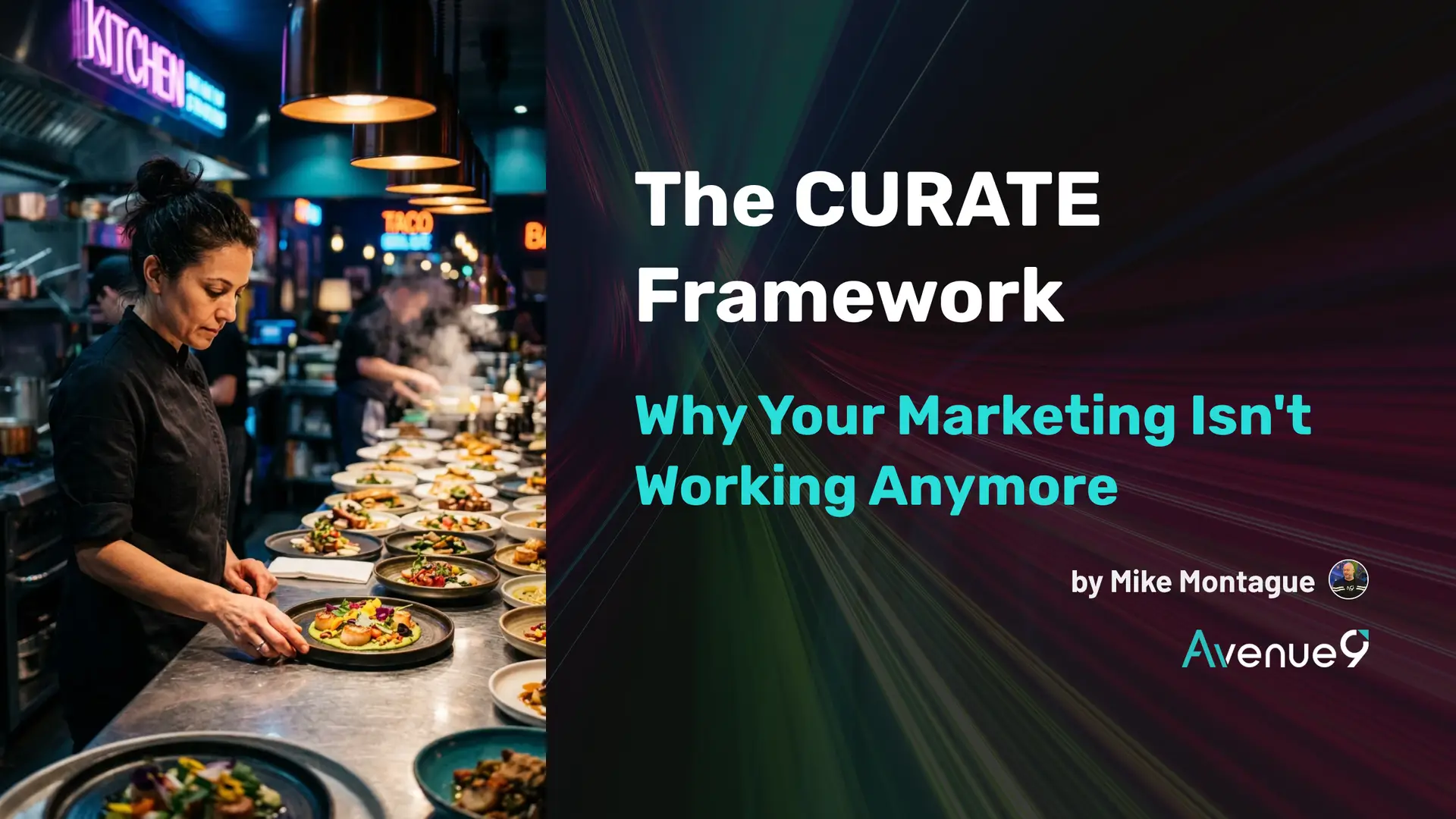
The CURATE framework gives you six ways to put AI to work in a human-first way to save your marketing.
In a world where you can make almost any marketing asset with AI, the question becomes: “Should you?”
Every week brings a new model, a new agent, a new notetaker, and presumably an AI-powered toaster with a waitlist. So, naturally, we all ask the same question: “What can AI do?”
That question has an infinite answer, which is why your marketing is failing. Infinite supply with a limited demand means that it’s going to be worthless.
I’ve spent years using AI daily, training teams on it, and interviewing over 100 experts and practitioners on the podcast. People know AI can do a lot; almost nobody has a mental model for where it actually belongs in their work.
That’s why I developed the CURATE framework to give you six ways to leverage AI without burning out, burning bridges with your audience, or burning cash.
Think about how a chef curates a menu at a fine dining restaurant.
Most likely, she didn’t grow all the ingredients, build the oven, or forge the knives, and on a busy night she isn’t plating all 200 covers herself. Instead, her job is to decide what the restaurant is, what makes the menu, what gets cut because no one would order it, and what quality of dish gets served with her name on it.
In a sense, AI just handed each of us a bigger kitchen, more hands, and a pantry that refills itself hourly, but your guests did not get an infinite stomach. You could make a million dishes this month, but your audience can only consume so much.
The most valuable marketing skill in the AI era is deciding what gets served and when.
That’s the premise of Human-First AI Marketing®. AI is like a great sous chef who makes the chef better, but doesn’t get to choose the menu.
The CURATE FRAMEWORK
- Capture activity and turn it into context
- Understand more to make better decisions
- Research what you don’t know
- Author a first draft or make something original
- Transform and improve what already exists
- Execute repeatable work and amplify positive results
C is for Capture
Your marketing pantry is already full. Everything you need to make magic happen for your client lives in meetings, sales calls, support threads, and the founder’s head, and none of it is written down.
My numbers here are ridiculous. I used to burn hours every week typing up notes, ideas, and presentations, and for years I paid production assistants overseas hundreds of dollars a month to transcribe and clean up podcast interviews. That whole pipeline now takes me under 15 minutes with Wispr Flow, Descript, and Zoom AI Companion. I’ve dictated roughly two business books’ worth of ideas into AI, without typing a single one of them. I have transcribed hundreds of hours of interviews and client calls that I can quickly turn into context for my marketing.
Better AI starts with better input, which is the argument behind Context Engineering. Before you ask AI to create more stuff from scratch, get better at collecting what you already have.
U is for Understand
Don’t outsource your thinking. Improve it.
I use ChatGPT most often as a sparring partner: “Here’s my recommendation. Give me the three strongest arguments against it and tell me what I’m probably overlooking.” I use it to find patterns, beats, and insights from massive amounts of data that I otherwise would not have time to process myself.
Now that you have captured all those conversations, leverage AI to sort, filter, and distill the insights.
R is for Research
Research what is not in your conversation collection: competitor moves, vendor comparisons, evidence, and the fifteen tabs you haven’t had time to read. AI can help you find the evidence for the case you are trying to make, but just remember that it doesn’t relieve you of the responsibility to check those facts.
A is for Author
The end of the blank page is a real gift for most marketers. Most people find it easier to get into editing mode in ninety seconds instead of ninety minutes. Turning an idea into reality quickly is a major plus, but that doesn’t mean all of the ideas are good.
A great chef is still an artist regardless of the tools she uses to make the dish. She decided what the dish is, tasted it four times, and sent it back twice because it wasn’t quite right.
I chose the word Author purposefully because whatever you create is still being published under your name, and that matters. AI preps. You author.
T is for Transform
Most people don’t know that the T in ChatGPT stands for Transform. AI is excellent at repurposing stuff you have already made. It can turn
- A 50-page report into a brief somebody will actually read
- A podcast into a blog post, a LinkedIn post, and a newsletter
- A generic email message into one written for a specific individual
It’s what I call the Degenerative AI Method. Instead of asking AI to make something from scratch. Give it your best ingredients, or even leftovers, and ask it to transform it into something new.
E is for Execute
AI Agents are like your kitchen staff: recurring reports, meeting prep, follow-up drafts, CRM updates, monitoring, scheduled research. Your progression in AI adoption runs similar to a chef’s progression from prep cook to sous chef. As you get better with AI, you move from running prompts to assigning tasks, designing workflows, setting up automations, and finally developing agents to act as marketing assistants.
Just make sure that autonomy gets earned, and you still double-check anything you ask AI to execute.
Curating the Customer Experience
Once you get good at using AI to make marketing assets, the true test of whether you will succeed or not comes down to judgment.
- Is this honest and authentic?
- Does it sound like us?
- Will anyone enjoy consuming this?
- Am I willing to put my name on it?
Then there’s the question almost nobody asks. “Was it hard enough to make that my competitors are going to give up?”
If it is easily done with AI, anyone can do it, including your customers and competition, so what becomes valuable is the stuff other people are not willing to do. You know the expensive, time-consuming, emotionally vulnerable, and risky stuff that other people stay away from.
Your ideal client has a finite appetite. They can only absorb so much from you, and every weak AI output costs you a little trust. I limit my output by my creative energy and by my ideal clients’ available bandwidth.
Buffets are cheap for a reason. No one wants your marketing slop.
Nobody Sends a Compliment to the Oven
If a chef serves a bad dish, the customer doesn’t blame the oven. The same thing goes for your boss, team, and customers.
The most dangerous thing I see marketers doing is trusting AI to do the curating, to make the strategy calls, and to build the marketing plan for you. You are the one on the hook, so make sure you curate output that you are proud of.
Connect with me on LinkedIn and subscribe to the Human-First AI Marketing YouTube channel for more frameworks, experiments, and interviews about how to best leverage AI in your marketing and how to turn your expertise into content, conversation, and clients.