Search is changing faster than most businesses realize.
For years, marketing teams fought for rankings on Google. You researched keywords, optimized pages, chased backlinks, and hoped your website would climb high enough to earn clicks. That world still matters, but it is no longer the whole game.
Today, buyers are asking ChatGPT, Gemini, Claude, and Perplexity for answers directly. They are not scrolling through ten blue links anymore. They are asking AI for recommendations.
That changes the job of marketing entirely.
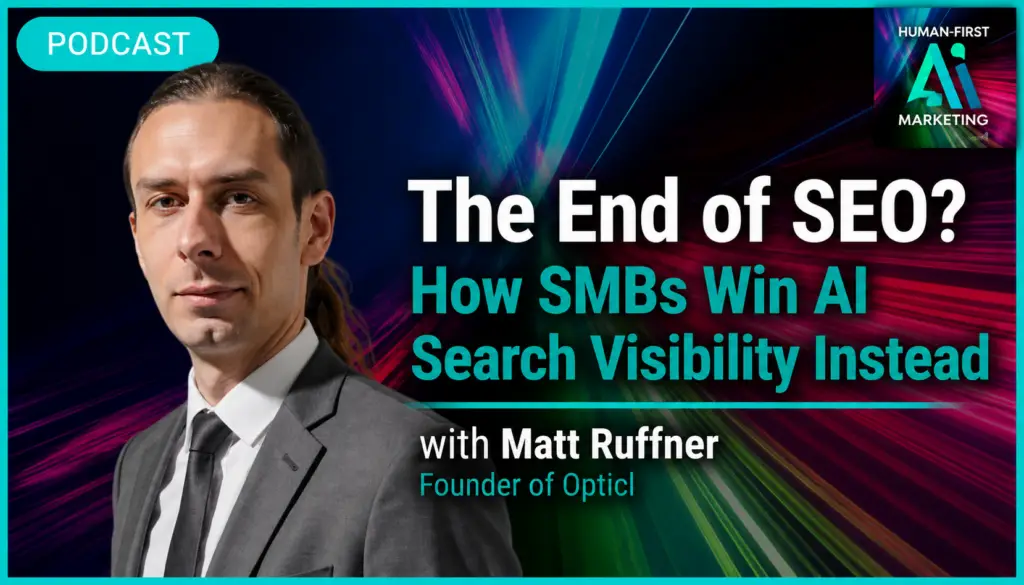
On a recent episode of the Human-First AI Marketing Podcast, I sat down with Matt Ruffner from Opticl.ai to unpack what this shift means for SMB business owners and marketing leaders. The conversation confirmed something I’ve been saying for months:
SEO was about being found.
AEO is about being trusted.
That sounds simple, but it changes almost everything about how modern businesses need to think about visibility, authority, and marketing strategy.
AI Search Is Moving Faster Than Google Ever Did
One of Matt’s biggest insights was how quickly AI search is evolving compared to traditional SEO.
Google used to roll out major updates every year or two. Then every few months. Now, AI models are constantly retraining and changing their behavior. New features, new data sources, new recommendation patterns, and new interfaces are appearing almost quarterly.
Most SMBs are still treating AI like a side project while the entire search ecosystem quietly shifts underneath them.
It reminds me of businesses that ignored smartphones in 2008 because desktop traffic still looked fine. By the time they reacted, customer behavior had already changed.
That is where we are right now with AI search.
The companies building trust, authority, and AI visibility today are planting trees. Everyone else is shopping for fake fruit.
AI Does Not Rank Websites Like Google
Traditional SEO was heavily technical. Keywords, backlinks, metadata, domain authority, page structure.
AI still uses some of those signals, but it evaluates trust much more as a human would.
That was one of the most important lessons from my conversation with Matt.
AI systems can now interpret:
- Review sentiment
- News coverage
- Thought leadership
- Community involvement
- Consistency of messaging
- Author expertise
- Social proof
- Brand reputation
- Video transcripts
- Customer language and context
In other words, AI is trying to figure out whether your company deserves to be recommended.
That is a radically different objective than simply ranking pages.
This is why I believe Human-First AI Marketing® matters so much right now. The businesses winning in AI search are often the same businesses already focused on relationships, expertise, trust, and reputation.
AI is amplifying authenticity faster than it amplifies manipulation.
Your Brand Is Becoming a Knowledge Graph
One of the clearest metaphors I can give business owners is this:
Google used to act like a librarian organizing bookshelves.
AI acts more like a trusted advisor at a networking event.
When someone asks, “Who should I hire?” AI is pulling together everything it knows about your company across the internet and forming an opinion.
That opinion is shaped by:
- Your website
- Your YouTube videos
- Your LinkedIn content
- Your podcast appearances
- Your reviews
- Your employee sentiment
- Your local reputation
- Your expertise
- The consistency of your message everywhere
Every piece contributes to the “mental model” AI has about your business.
That means fragmented marketing is becoming extremely dangerous.
If your website sounds corporate, your LinkedIn sounds robotic, your reviews are stale, your YouTube channel is abandoned, and your messaging changes every month, AI will see inconsistency rather than authority.
Trust compounds through consistency.
Why YouTube and Podcasts Suddenly Matter More
One of Matt’s smartest observations was how much AI systems rely on video and transcript content.
Google owns YouTube. AI tools can crawl transcripts. Podcasts contain natural language, expertise, and conversational context. That makes them incredibly valuable for AI visibility.
This is one reason we lean heavily into podcasts, interviews, webinars, and conversational content at Avenue9.
Conversations are more trustworthy than polished marketing copy.
Founders explaining real challenges. Customers sharing real outcomes. Experts discussing real-world experience. AI systems love this because humans love this.
I call this “degenerative AI.” Instead of generating endless synthetic content from thin air, you start with authentic conversations and let AI help scale, organize, repurpose, and distribute them.
Your best marketing asset is probably already happening inside your sales calls, customer meetings, podcasts, and founder conversations.
Most companies simply are not capturing it.
Local Businesses Have an Advantage
Here is the good news for SMBs.
You do not need a Fortune 500 budget to win AI search visibility.
In fact, local businesses often have an advantage because trust is easier to demonstrate at the community level.
Matt shared several factors AI systems increasingly value for local visibility:
- Google Business Profile optimization
- Community sponsorships
- Local events
- Charitable involvement
- Local press mentions
- Authentic customer reviews
- Consistent business information
That means your local reputation is becoming part of your digital visibility strategy.
A business sponsoring youth baseball, supporting local nonprofits, speaking at events, and generating authentic customer advocacy is building stronger AI trust signals than businesses gaming backlinks from random websites.
That should encourage every relationship-driven SMB owner reading this.
The Biggest Mistake Businesses Are Making Right Now
Most companies are still treating AI like a vending machine. They prompt it for content. Push a button. Post the output. Repeat.
That approach creates generic marketing because it skips the most important ingredient: context. You cannot outsource trust.
The businesses succeeding with AI are training systems on:
- Founder expertise
- Brand voice
- Customer psychology
- Sales conversations
- Unique positioning
- Real stories
- Internal knowledge
That is what we call Context Engineering at Avenue9. AI performs best when it understands your business deeply enough to amplify your expertise rather than replace it.
Otherwise, you are just accelerating mediocrity.
What SMB Leaders Should Do Next
If you are an SMB owner or marketing leader, here is the practical takeaway:
Do not panic about SEO dying.
Instead, expand your thinking beyond SEO.
Start building:
- Trust signals
- Thought leadership
- Conversational content
- Video assets
- Founder visibility
- Review quality
- Community reputation
- Multi-platform authority
- Consistent messaging
Most importantly, stop thinking like a publisher trying to feed algorithms.
Start thinking like a trusted expert and build a reputation.
Because that is what AI is ultimately measuring.
The future of marketing belongs to businesses that humans trust enough for AI to recommend.
And that future is already here.
If you want help building a Human-First AI Marketing® strategy that improves your visibility in ChatGPT, Gemini, Google AI Overviews, and beyond, reach out to the team at Avenue9. We help SMBs scale trust, authority, and marketing momentum without sounding robotic or burning out their teams.
Check out Avenue9’s AI Trust Profile on Opticl