AI ethics can sound like a graduate seminar wearing a hoodie.
You hear words like sentience, singularity, consciousness, agentic systems, hallucinations, alignment, and suddenly your marketing meeting feels like it needs a priest, a lawyer, a therapist, and someone from IT.
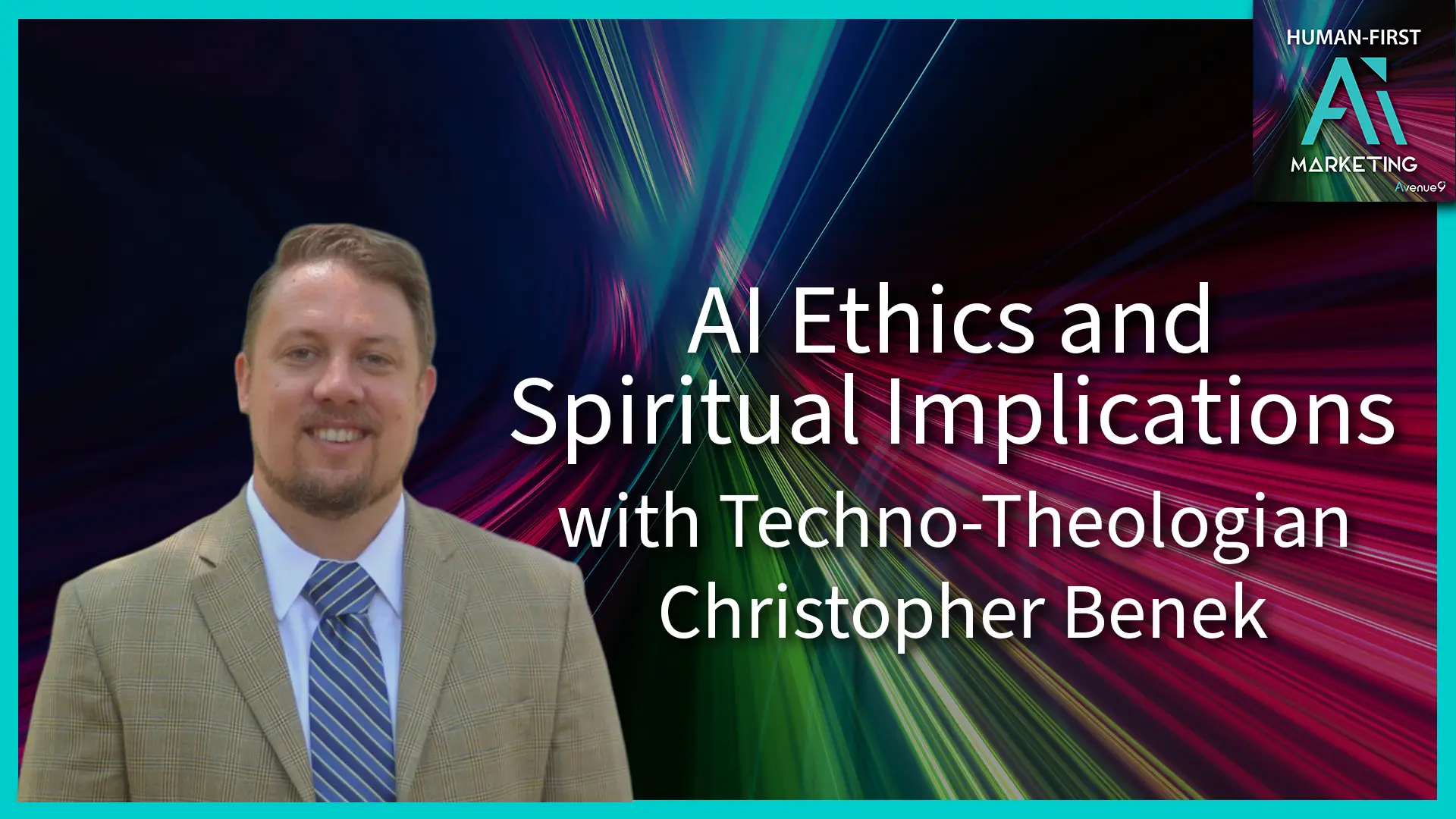
That is why I enjoyed my conversation with Reverend Dr. Christopher Benek, a techno-theologian and author of The Church Leader’s Guide to Artificial Intelligence. Christopher brought the rare combination this topic needs: optimism, humility, humor, and a willingness to ask the big questions without floating away into sci-fi fog.
The most practical lesson from our conversation was that AI ethics starts with knowing what kind of human, leader, company, and community you want to become.
For SMB owners and marketing directors, that matters more than ever. Your buyers are already using AI. Your competitors are experimenting with AI. Your team is probably using AI, even if they are only admitting to “light brainstorming,” which is the business equivalent of saying you only had “one handful” of chips.
So, here are the biggest lessons from Christopher Benek’s episode and what they mean for your business.
1. AI Is Still in the Fiddling Stage
Christopher describes himself as a technological optimist. He believes we are still on the front end of AI as a human-created technology, and like every major technology before it, humans need time to figure out how to use it well. He compared this moment to previous leaps like transportation, flight, and the moon landing, where the shift felt massive because it was massive.
That perspective is helpful for business leaders because it lowers the panic temperature in the room.
AI feels overwhelming because everyone is talking about it, every platform is adding it, and every vendor is promising that their tool will make your business run like a Fortune 500 company by Tuesday afternoon.
The better move is to treat AI like a new power tool in the shop.
A power tool can help you build faster, cleaner, and with more precision. It can also take off a finger when the person using it has no training, no plan, and too much confidence.
The tool is early. Your strategy should be mature.
For SMBs, that means you need a practical AI adoption plan. Start with the work your team already does. Look for places where AI can help with research, summarization, first drafts, repurposing, follow-up, reporting, and personalization. Then decide where humans need to stay in charge.
At Avenue9, this is exactly why we start with Human-First Strategy inside the A9^Factor Framework™. The order matters. Clarity comes before automation. Your audience, voice, offer, values, and customer relationships should guide the tool decisions.
2. Ethics Depends on Context
One of Christopher’s most useful points was that AI ethics is contextual. People often ask whether their use of AI is ethical, and his answer is that the same use case can be appropriate in one profession or situation and harmful in another.
That should be printed on a coffee mug and handed out at every AI webinar.
Using AI to draft a blog outline is usually low risk. Using AI to respond to a customer in crisis is a higher-stakes decision. Using AI to summarize a sales call can save time. Using AI to invent a customer quote is a trust bonfire with a keyboard.
The ethical question for business leaders is less about whether AI can do the task. The better question is whether AI should be involved in that moment, with that customer, for that purpose, under those conditions.
Here is a simple business filter:
- Does this task require human empathy?
- Does this task affect someone’s money, job, safety, reputation, or trust?
- Would I be comfortable telling the customer AI helped with this?
- Is a qualified human reviewing the output?
- Do we have enough expertise to catch mistakes?
That last question matters. Christopher warned people to be cautious with answers from LLMs because they can be wrong and depend heavily on the data they are pulling from. He emphasized that people still need expertise in their field.
For marketing directors, this is the line between leverage and laziness.
AI can help you move faster. Your expertise keeps the work accurate, useful, and brand-safe.
3. Your Voice Is a Business Asset
Christopher gave a powerful example from his own work. He uses AI to help outline sermons and create transitions, but he said that would have been risky when he was younger and had not yet developed his own voice.
That point should hit every business owner directly in the brand.
AI can imitate a voice. It can summarize a voice. It can smooth a voice until every rough, interesting edge disappears. Your voice is the difference between generic content and content people recognize as yours.
That includes your founder stories, customer language, sales conversations, hard-earned opinions, industry scars, and the little phrases your team uses when they actually understand the buyer. SMBs often think their disadvantage is smaller budgets. In an AI-saturated market, their advantage can be a more distinct point of view.
Big brands often have layers of approval that sand everything down into beige oatmeal. Smaller companies can sound more human, specific, and trustworthy because the leader is closer to the customer. AI can amplify that voice once you define it.
That is why Avenue9 spends so much time on context engineering. We capture the real ingredients: podcast transcripts, sales calls, customer stories, founder beliefs, FAQs, objections, and proof points. Then AI has something worth cooking with.
Otherwise, you are asking the machine to make dinner from a pantry full of air.
4. Automation Should Free Us to Be More Human
Christopher said the purpose of automation is to help us live more fully into the parts of ourselves that feel most human. He also said we discern what makes us human in community, rather than as isolated individuals.
That is a beautiful idea for business leaders.
AI should free your team to do the human work better: listening, advising, creating, selling, teaching, leading, solving, and building relationships.
For marketing teams, that means AI should help with the heavy lifting around drafts, summaries, segmentation, analysis, and repurposing. Then humans should bring judgment, empathy, humor, taste, and timing.
Think of your marketing system like a restaurant kitchen. AI can prep ingredients, organize orders, suggest recipes, and clean up the mess. The chef still decides what belongs on the menu, how the meal should taste, and what kind of experience the guest should have.
Your marketing director is the chef. AI is the prep team with suspiciously fast knife skills.
That model keeps AI in its proper role. It creates leverage without handing over the customer experience to a machine that has never had a bad sales call, a disappointed client, or a kid walk into the office during a Zoom meeting.
5. Technology Can Become a “Little g god”
Christopher brought a spiritual warning into the conversation that applies beautifully to business. He said humans can turn anything into a “little g god” by giving it too much power, attention, and authority.
That is a real risk with AI.
A business can start treating AI like the answer to every problem. Bad positioning? Use AI. Weak offer? Use AI. Inconsistent follow-up? Use AI. Low trust? Use AI. No sales strategy? Use three AI tools and a dashboard.
That path creates expensive confusion with better fonts.
AI deserves a seat at the table. It should not sit at the head of the table.
For SMB owners, the leadership move is to name your non-negotiables before you scale automation.
For example:
- We will disclose AI use when it materially affects the customer experience.
- We will never publish AI-generated claims without verification.
- We will protect customer data.
- We will keep humans involved in emotionally sensitive conversations.
- We will use AI to strengthen trust, consistency, and service quality.
Those rules do not slow you down. They keep you from driving faster in the wrong direction.
6. Human Responsibility Stays with Humans
Christopher warned that it is easy to give our power over to LLMs and automations. His point was direct: humans are creating these systems, so humans need to stay responsible for how they are used.
That is the leadership sentence every AI policy should start with.
You can delegate a task. You still own the outcome.
If an AI email annoys your prospects, they blame your company. If an AI chatbot gives a bad answer, they blame your company. If AI-generated content misrepresents your offer, they blame your company.
The market does not care which software caused the mistake.
Responsibility is the part of AI adoption that vendors rarely put on the pricing page.
For marketing directors, this means every AI workflow needs ownership. Someone should know what the tool is doing, what data it uses, what outputs it creates, who reviews those outputs, and what happens when something goes sideways.
A Human-First AI Marketing® system is built around accountability. That means humans set the strategy, humans define the standards, and humans review the moments that matter.
7. Avoidance Leaves the Future to Someone Else
Christopher made another important point: fleeing from involvement does not change the problem in a positive way. He said people need to stay engaged with AI because participation matters.
That is especially true for SMBs.
Sitting out the AI shift does not protect your business. It gives your competitors more time to learn, test, fail, improve, and build systems while you are still hoping the whole thing turns out to be a fad.
AI will keep showing up in buyer research, customer service, content creation, search, sales enablement, analytics, operations, and internal productivity.
Your choice is to participate with values or get dragged into participation by market pressure.
I recommend the first option. It is better for your blood pressure and your margins.
Start small. Pick one workflow. Build one useful AI assistant. Turn one podcast into five pieces of content. Create one sales follow-up system. Summarize one month of customer calls and look for patterns.
Participation creates clarity. Clarity creates confidence. Confidence creates better decisions.
8. More Voices Belong in the AI Ethics Conversation
Christopher pushed for more voices in AI ethics, especially beyond a small group of Silicon Valley leaders. He shared that his church includes people from many nationalities, and those perspectives help him see things he would otherwise miss. He also connected this to justice, equity, and the need to include more lived experiences in the conversation.
For SMBs, this is practical. Your AI strategy should include the people closest to your customers.
That means sales, service, operations, field teams, account managers, support staff, and even customers when appropriate. These people hear the real objections, frustrations, hopes, and buying triggers.
A boardroom-only AI strategy will miss too much.
Invite more voices into the process. Ask your team where AI could reduce frustration. Ask customers which parts of your communication are confusing. Ask sales what content would help buyers make decisions. Ask service what questions customers repeat every week.
The best AI systems are trained on the truth from the front lines.
9. AI Can Be a Mirror
One of my favorite ideas from Christopher was that AI can act like a mirror. He described arguing with ChatGPT, pushing back on answers, and using the dialogue to discover what he thinks and believes more clearly.
That is one of the healthiest ways to use AI. Use it to reflect your thinking back to you. Ask it to find gaps. Ask it to challenge assumptions. Ask it to summarize your strongest point. Ask it to identify where your argument gets fuzzy. Ask it to turn a messy idea into a sharper outline.
AI works well as a mirror because it gives you something to react to. This is especially useful for marketing leaders who have too many half-formed ideas in their head and too little time to turn them into campaigns.
Record a voice memo after a customer call. Drop it into AI. Ask for themes, quotes, objections, and follow-up content ideas. Then review it as the human expert. That process turns raw thinking into usable strategy.
10. The Future Starts with What You Do Right Now
Toward the end of the conversation, Christopher brought the big futuristic questions back to the present. He said we can get so caught up in the potential future that we miss our relationships, our businesses, our communities, and the good we can do right now.
That is the business lesson. You do not need to solve consciousness to improve your marketing this quarter. You need to decide how AI can help your team serve customers better, communicate more clearly, follow up more consistently, and build trust at scale.
Start there. Ask better human questions:
- What do our customers need from us?
- What do they trust us for?
- Where are we creating friction?
- Where is our team wasting energy?
- Which conversations should stay deeply human?
- Which repeatable tasks can AI support?
- What values should guide every automation?
That is AI ethics for SMBs. It is less dramatic than the Terminator version. It is also much more useful before lunch.
The Avenue9 Takeaway
AI ethics belongs inside your marketing strategy because trust is now a competitive advantage.
Your customers can smell generic automation. Your team can feel when tools are being forced into broken workflows. Your prospects can tell when personalization has no person behind it.
Human-First AI Marketing® gives SMBs a better path.
Start with what you already know: your point of view, your values, your customers, and the people doing the work. Then bring in AI to help carry that message farther, faster, and more consistently.
That is how small and mid-sized businesses can market with the clarity, confidence, and capability of a big brand without burning bridges or blowing out the budget.
If you want help building an AI marketing system rooted in your actual voice, customer relationships, and business goals, Avenue9 can help. Let’s build a smarter, more human marketing engine together.