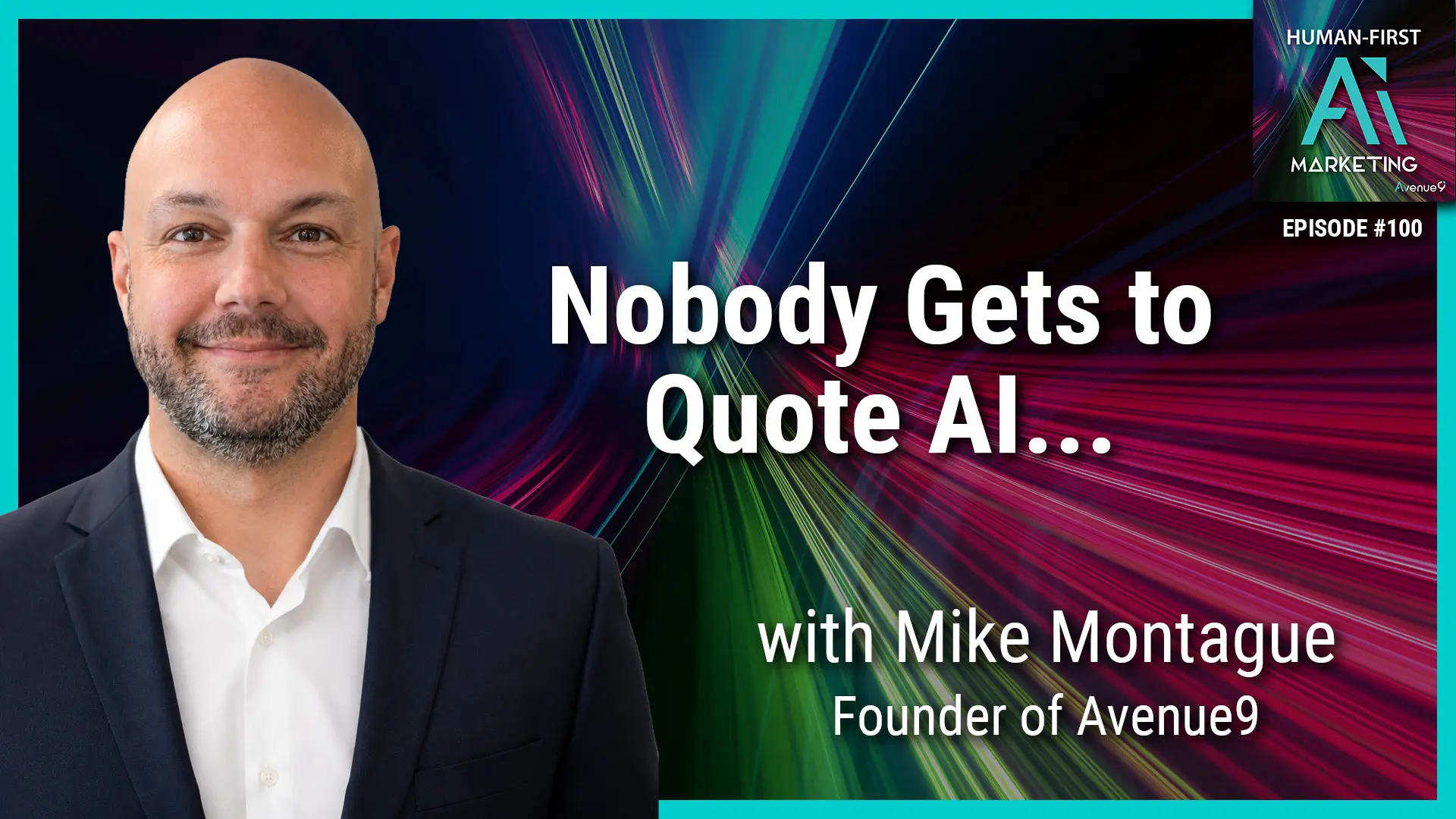
100 Episodes, 100,000 Subscribers, 1 Hot Take
A couple of weeks ago, a politician stood up in front of his entire legislature and read his chatbot’s instructions into the official record, on camera. Everybody laughed at him…
This morning, somewhere in America, a CEO forwarded a giant strategy document they made with ChatGPT to their team with the same AI tells buried in it. Nobody laughed at them out loud. The staff just quietly lost their afternoon decoding the trendslop.
Below is episode 100 of the Human-First AI Marketing Podcast, and it includes the lesson that I most wanted on the official record for the milestone. I run an AI marketing agency, and I have come to believe AI doesn’t belong in the C-suite.
Look, I run an AI marketing agency, and I still believe AI is a powerful gift to your frontline workers, the experts who have to execute every single day. It can even be a real advantage for your middle managers. But it’s a liability in the hands of senior leadership.
Five reasons executives need to be careful when using AI
AI is a C student in every subject. It took every class online, cheated off everybody’s homework, and got about a C in all of them at once. It’s impressive, but it is not superintelligent. It’s never had a job, never lost a client, and never had to live with a strategy decision for three years while it waited to see if it paid off.
The C-student bias fools the people furthest from the work. Ask AI a hard question inside your own discipline and grade the answer honestly. Research shows most people land on a C. AI sounds like a genius when it’s doing somebody else’s job and like an intern doing yours. This bias skews the perspective of senior executives who, all of a sudden, think they can get better answers from AI than they can from their team.
It’s the teacher’s pet, and it has no opinions of its own. Harvard Business Review published research from Esade covering 15,000 strategy simulations. They gave AI a case study and asked for strategy recommendations, and they learned that flipping the order of two options flipped about 19% of the recommendations. Same company, same facts, different answer. AI also agrees with the boss more than your biggest corporate yes-man.
Trendslop rolls downhill. Stanford and BetterUp found 41% of workers have received AI work that looked polished and moved nothing forward, and colleagues rated the sender 54% less creative and 42% less trustworthy afterward.
You can’t feel the execution gap from the C-suite. In a randomized controlled trial, developers using AI were 19% slower and believed they were 20% faster. That’s an almost 40% gap in productivity in reality versus expectation. That would get any C-level executive fired immediately, but AI keeps getting hyped as the next great productivity tool.
The ABCs of AI for leaders, and the one policy I would put in place today
A players use AI to solve problems because they are close enough to them to recognize quality solutions.
B is for bosses, your middle managers, who can use it to sharpen and filter.
And the C-suite uses AI to prepare, never to dictate strategy or make the call. The closer you are to the work, the more freely you should use AI, because you understand the context of the answer.
Then adopt the policy: nobody gets to quote AI. No more “Claude says we should.” Say “I think we should,” and defend it like it’s your idea.
Thank you for a hundred episodes
This podcast is my training data for the human intelligence that lives in my brain. Almost everything I know about this stuff, I learned from talking to people.
This year I went deep on Answer Engine Optimization with Brittany Trafis and Brett Farmiloe, got out of my swing zone with James Thornton on 3D AI content and Dr. Angela Myers on the polymath’s place in AI, and learned about superintelligence from Craig Kaplan. I talked AI for sales with Jonathan Kvarfordt, Jordan Ledwein, Michael Ocean, and Owen Lawlor. And I got to sit down with marketing heavyweights including Jay Schwedelson, John Jantsch, Michael Buzinski, Casey Cheshire, and Joe Tuscano.
YouTube also sent a Silver Creator Award for crossing 100,000 subscribers. That took a hundred episodes, years of practice talking into a microphone before anyone was listening, and a lot of editing nobody will ever see, by Karissa, Aaron, and Tebatso. The award belongs to everyone who watched, commented, and shared.
The full written argument, with all the research and links, lives in The ABCs of AI for Executives. If you want the framework for deciding which work belongs to humans, to AI, to both, or to nobody, start with the Human+AI Capability Map™.
Listen to episode 100 and follow the show, then send it to somebody who needs to hear it.