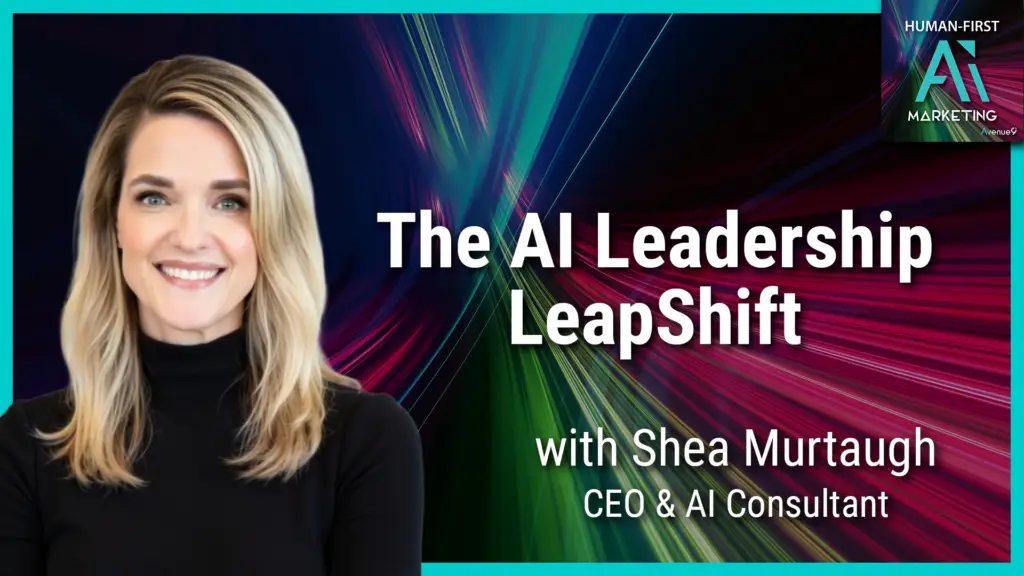
I had a great conversation recently with Shea Murtaugh, CEO of Hoffman Murtaugh and founder of LeapShift AI Collective, and halfway through the interview I realized we were no longer talking about AI tools.
We were talking about operating systems for modern businesses. That’s the real shift happening right now.
Most SMB owners are still asking, “What AI tool should we use?” Meanwhile, the companies pulling ahead are redesigning how work gets done altogether. Different question. Different game.
Shea said something early in the conversation that stuck with me. She feels like she’s producing 120 hours of output inside a normal 40-50 hour work week. That sounds insane until you see her workflows. Then it starts making uncomfortable amounts of sense.
She built an entire AI community brand in a single afternoon. Name research. Logo. Website. Intake forms. Positioning. Done.
A few years ago, that project would have required a designer, copywriter, strategist, developer, several meetings, and at least one person saying, “Let’s circle back next week.”
Now? One focused operator with context and AI systems can move like a small agency.
That should excite you a little. It should also concern you a little.
Because this isn’t just a productivity upgrade. It’s a pressure upgrade.
AI Is Compressing Time
Most people still think AI saves time the way a Roomba saves time. Tiny efficiency gains. Fewer repetitive tasks. Maybe you answer emails faster.
That’s underselling it badly.
The bigger shift is cognitive compression.
One person can now think through ideas, test messaging, build drafts, generate creative options, pressure-test strategy, and execute campaigns without waiting on five departments to catch up.
That changes the economics of small business completely.
The SMB advantage used to be agility. Now it’s amplified agility.
Large enterprise teams still need approvals, procurement reviews, legal reviews, security reviews, brand reviews, steering committees, and whatever other ceremonial rituals corporations invented to avoid making decisions before Q4.
Meanwhile, smaller companies can wake up Monday morning and launch something by lunch.
That speed matters.
Especially in marketing.
Most Businesses Are Using AI Backward
One of the smartest points Shea made had nothing to do with prompts. She talked about labor.
Her agency currently operates around 80% labor costs. Her goal is not layoffs. Her goal is scaling revenue while keeping the team intact and letting AI absorb lower-level production work.
That’s a very different mindset from the panic-driven “AI will replace everyone” narrative floating around LinkedIn right now.
Here’s the practical reality I’m seeing with our clients at Avenue9: The companies winning with AI are usually not replacing their best people. They’re removing friction around their best people.
There’s a difference.
A great marketer spending four hours formatting slides is wasteful. A great strategist manually rewriting social captions for every platform is wasteful. A founder staring at a blank page for an hour trying to start a newsletter is wasteful.
AI helps remove the drag coefficient from knowledge work.
That’s why I keep saying Human-First AI Marketing® is about amplification, not replacement.
The human still matters most.
Actually… the human matters more now because direction matters more now.
AI is phenomenal at execution. Humans are still responsible for judgment, taste, leadership, trust, and deciding what deserves amplification in the first place.
The Real Gold Is Context
Most businesses are still treating ChatGPT like a vending machine.
Push button. Receive content nugget. Feel disappointed.
Then repeat.
Shea’s workflows were much more interesting than that.
She builds custom agents trained around communication styles, leadership profiles, strategic thinking patterns, and client context. She described building “agency brains” that understand personalities, positioning, and workflows.
That’s where this is all heading.
The real competitive advantage in AI will not be prompts. Prompts are becoming commodities already.
Context wins.
The businesses that feed AI real customer conversations, founder stories, sales calls, objections, positioning, and institutional knowledge will outperform companies feeding generic internet sludge into the machine.
I see this every day.
The difference between generic AI output and great AI output is usually the same difference between frozen pizza and a private chef. The tool matters less than the ingredients and the person directing the kitchen.
Her Conference Workflow Was Wild
One of my favorite parts of the interview was hearing Shea explain her live conference content system.
She creates project folders in ChatGPT before events. Builds context around keynote speakers. Takes photos during presentations. Records audio snippets. Generates implementation plans and LinkedIn posts while the speaker is still on stage.
Honestly, this is where SMB marketers need to wake up a little.
Most teams still attend conferences like tourists.
Take a few notes. Collect tote bags. Post one blurry photo afterward with “Great networking at the event!”
Meanwhile, smarter marketers are turning every conference into a 30-day content engine.
That’s the real shift AI creates. Not more content for the sake of content. Better extraction of insight from experiences you’re already having.
I’ve started calling this “degenerative AI” because the smartest marketers are not generating random content from thin air. They are breaking down real conversations, real expertise, and real experiences into scalable assets.
That feels much more sustainable to me.
And frankly, much more human.
AI Is Increasing the Value of Clear Thinking
Here’s the weird thing nobody tells you about AI productivity.
The bottleneck becomes your brain.
Once execution speeds up, weak strategy becomes painfully obvious.
Bad positioning gets exposed faster.
Confused messaging spreads faster.
Mediocre ideas multiply faster.
AI acts a little like a gym mirror. It reflects whatever shape your thinking is already in.
That’s why some companies feel energized by AI while others feel overwhelmed by it.
The overwhelmed teams usually adopted tools before they clarified direction.
They automated confusion.
The sharper teams use AI after they know:
- who they serve
- what they believe
- how they communicate
- what problems they solve
- what kind of reputation they want to build
That sequence matters more than the software.
SMBs Have a Window Right Now
I don’t think mass AI adoption will happen as quickly as tech Twitter thinks it will.
Most business owners are still dabbling. Most marketing teams are overwhelmed. Most companies still haven’t integrated AI into actual workflows yet.
That creates a temporary opportunity.
Right now, a smart SMB can look much larger than it really is.
A five-person team can produce the consistency, visibility, and strategic execution of a 50-person marketing department if they build the right systems.
That’s a massive shift.
Especially for companies competing against bigger brands with slower processes and bloated operations.
The window probably won’t stay this wide forever.
But right now? It’s very real.
And the companies that figure out how to combine AI capability with human clarity are going to build a pretty unfair advantage over the next few years.
That’s the part that should get your attention.
If you want help building a Human-First AI Marketing® strategy that improves your visibility in ChatGPT, Gemini, Google AI Overviews, and beyond, reach out to the team at Avenue9. We help SMBs scale trust, authority, and marketing momentum without sounding robotic or burning out their teams.