Why building trust is the future of human-first automation
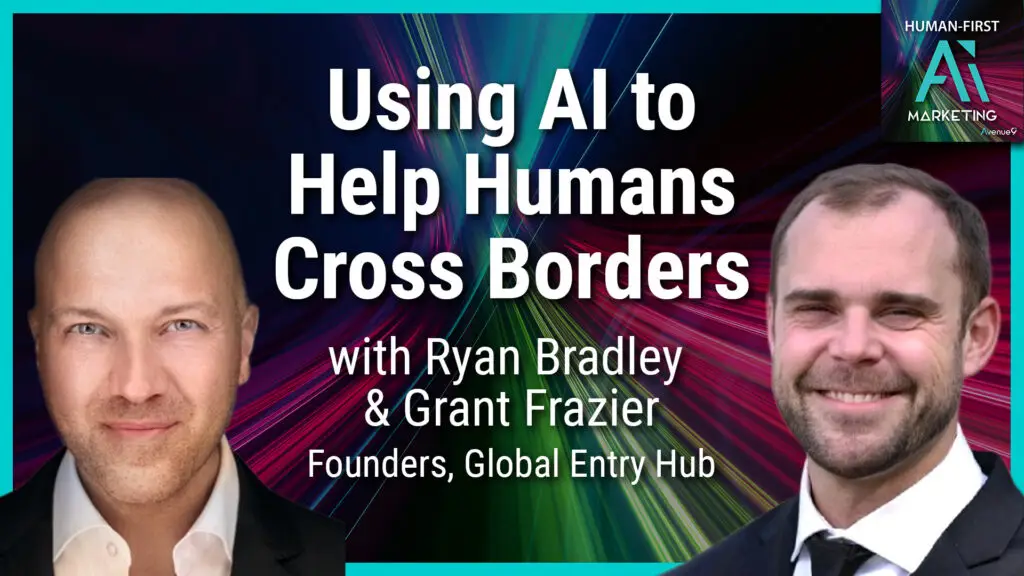
If you’ve ever been frustrated with AI tools that promise the world and deliver a clunky chatbot, you’re not alone. In a recent episode of the Human-First AI Marketing podcast, I sat down with Grant Frazier and Ryan Bradley, co-founders of Global Entry Hub, to talk about their journey building a multilingual AI assistant for immigration support.
Now, you might be thinking, “Cool story, but I’m not in the immigration business.” That’s fair. But what they’ve built and how they built it is a blueprint for anyone trying to scale with AI without burning bridges or blowing out their brand voice.
Lesson #1: Trust beats tech every time
When you’re helping someone move across borders, the stakes are high. One hallucinated answer or wrong visa requirement can derail someone’s future. So Ryan and Grant didn’t start with “What can AI do?” They started with “What can’t we afford to get wrong?”
They scoped their assistant, Mira, with hard boundaries. It speaks seven languages but only answers immigration questions it knows with confidence. No guesswork. No fluff. No spinning up a generic content bot and calling it a product.
That’s a principle SMBs can steal. If your AI amplifies chaos, you don’t have a tool. You have a liability.
Lesson #2: AI isn’t the magic… your data is
Behind Mira is a fortress of scrapers, APIs, logic trees, and self-updating data lakes. The UX is simple. The back end is intense. Why? Because they knew bad data leads to bad outcomes.
This is where most businesses miss. They slap AI onto outdated messaging, inconsistent brand voice, or CRM lists that haven’t been cleaned since the Obama administration.
The takeaway? AI can only work with what you give it. If your input is messy, your output will be a shiny mess.
Lesson #3: Global reach requires local relevance
Here’s something I hadn’t thought about until Grant brought it up. Most AI models are trained on Western data: Reddit threads, English documents, and US-centric assumptions. That creates bias. And if you’re serving global audiences—or even multicultural local ones—your content won’t land.
Think about your marketing. Are you pushing the same AI-generated blog post to everyone from Nashville to Nairobi? If so, you’re not scaling trust. You’re scaling noise.
Smart companies will start segmenting by language, culture, and context. Not just personas.
Lesson #4: You can’t fake empathy with AI
Grant and Ryan built Mira to be helpful, with incredibly accurate data. But they still back it up with human support. Why? Because no matter how accurate your AI gets, it can’t solve an emotional journey on its own.
Immigration is personal. So is buying a franchise, switching software providers, or rebranding your business. Big decisions carry big emotions. And customers don’t want a bot. They want clarity, confidence, and connection.
If your AI is replacing your human touchpoints instead of enhancing them, it’s time to rethink the playbook.
Lesson #5: Marketing automation without trust is just spam with lipstick
Here’s the kicker: when Global Entry Hub first launched, they leaned hard into AI-first messaging, and it fell flat. People liked the idea, but no one converted.
It wasn’t until they paired Mira with human follow-up, thoughtful positioning, and trust-building that the thing took off.
This is a pattern we see constantly at Avenue9. Tools don’t convert. Systems do. And the best systems connect with the people and businesses they serve.
So… what should you do with this?
Here’s the TL;DR for your marketing strategy:
- AI isn’t just a tool. It’s a mirror. If your strategy is broken, AI will just break it faster.
- Your audience doesn’t care that it’s AI. They care that it works, it helps, and it feels like you.
- Build guardrails before you build features.
- Lead with clarity and trust—then scale with automation.
And if that feels overwhelming, good news: we’ve built a framework for it. It’s called the A9^Factor, and it’s how we help businesses like yours go to market like the big brands—without losing what makes you human.