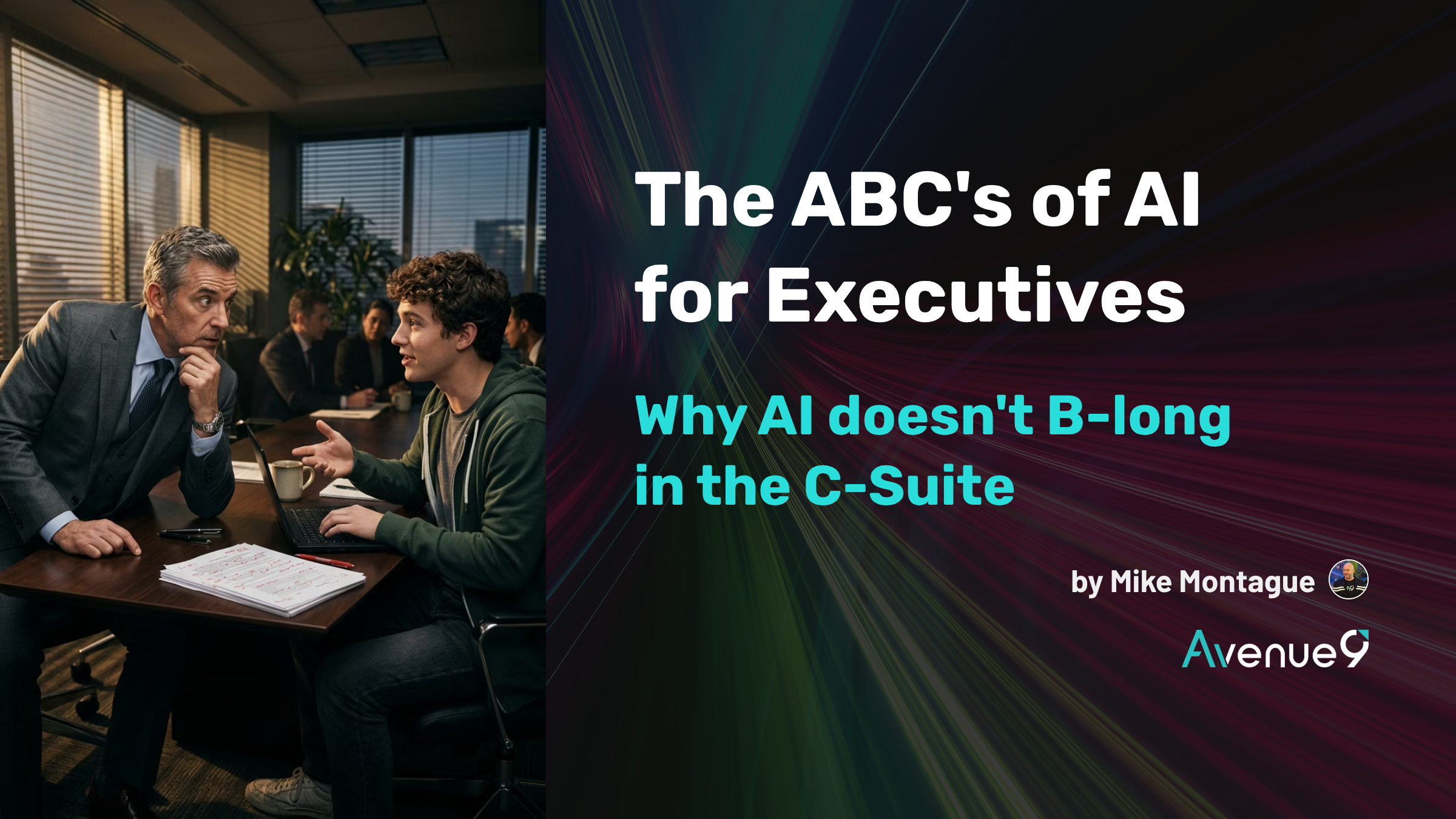
Here’s what happens to your company when you cheat off a C-student college intern’s homework
Last week, a member of the New Brunswick legislature stood up to speak about public trust in government. Partway through his remarks, he read this sentence out loud: “Here’s a more natural, flowing version of that section that reads like a legislative speech rather than a series of short points.”
He kept going. That was the chatbot’s line to him, and he read it into the official record of his province, in front of his colleagues, on camera.
We all laughed at how dumb he looked for blatantly using AI.
Then somewhere this morning in America, a marketing director opened a 94-page strategy document from her CEO accompanied by a one-word email: “Thoughts?” That strategy doc will have the same AI tells all over it, but because it’s her boss, instead of or despite laughing, she will spend her afternoon on it, even though he just spent a few minutes having his favorite AI chatbot write it for him.
Trendslop and workslop cost companies far more than the two hours it takes to read it!
AI doesn’t belong in the C-suite.
AI can be a gift to your frontline experts, a real advantage for your middle managers, and a liability in the hands of your senior leadership. I believe AI should run backwards up the org chart. The higher you sit, the less AI should touch your actual job. Mostly, this is because of how AI works. It is great complex math, coding, repetitive tasks, and sometimes it can speed up the creation of work product. However, it is terrible at leadership tasks like strategy, communications, consensus-building, trust, and unique, creative problem-solving.
Asking AI is not a leadership skill. Anyone can do it. A prompt is not an insight, and a printout of the response is not a point of view. When you forward what AI gave you to your team, you are showing how lazy, uninformed, and self-entitled you are.
It’s like using the Cliff’s Notes to grade an A-student’s homework.
AI is like a college intern that took every class available online and got a C in every single one by cheating off of other people’s papers.
OpenAI built a benchmark called GDPval to see how their models handle real work. Not trivia, not puzzles; 1,320 actual work products drawn from 44 occupations, each one designed by a professional with over a decade in the field, each one taking a human expert about seven hours. Then they had other experts in those same fields grade the outputs blind against the human deliverable.
The best model matched or beat the human expert a little under half the time.
As a letter grade, I would give that a C. Not a failure, and nowhere close to genius. This is OpenAI’s own benchmark, built by the people with the strongest possible incentive to make their model look brilliant, and it says their model is an extraordinarily well-read C student.
I want to be fair to AI, because it is truly remarkable. No human could ever do this. It took every class. Marketing, law, nursing, business, tax accounting, physics, math, and computer engineering. It cheated off of everyone’s homework, read everything on the Internet, and got about a C in every possible discipline. Admittedly, it might be a bit higher in math or coding, and a bit lower in philosophy or screenwriting, but for the most part, if you asked educated experts in the field, for routine work it would get a passing grade. It shows up instantly, works for hours, never complains, and there is a lot to like about this new AI intern.
An instant C feels like a steal when you’re currently sitting at an F. That’s exactly why the AI dazzles people who aren’t A or B players in the subject at hand. (Or are being lazy and taking the easy C.)
If you ask AI about a discipline you know nothing about, you get back a fluent, organized, confident answer, and it reads like brilliance because it is way better than what you could have come up with.
However, it has also never had a job, never lost a client, never sat across from a customer who was angry for reasons nobody can really articulate, and never had to live with a strategy decision for three years as you wait for it to pay off. AI has read about all of it, but that’s different than knowing it.
Try this, and you’ll never unsee it. Ask AI a hard question inside your own discipline, the one you’ve spent twenty years in, and grade the answer honestly. Most people land on about a C. Serviceable, obvious, missing the few nuanced things that actually matter in practice.
I call it the C-student bias. AI sounds like a genius doing someone else’s job and like an intern doing yours. Your experts and A-players in your organization can recognize the C work in their subject the same way you can, which is why forwarding them AI output costs you more than it saves. They have to either dumb their work down to a C level, or spend twice as long redoing the homework of a C student.
The Curve Just Reset
Again, if you’re failing, a C is a lifesaver. If you have no website, use AI and put a solid C website on the internet this week. If you have no go-to-market plan, ask ChatGPT and get a competent one by lunch. When you’re sitting at an F, a C is a rescue helicopter, and I will never tell a small business owner to wait for perfect. Get it out there.
The trouble starts when everyone does it.
Unfortunately, in the free market, grades are relative, and AI is quickly resetting the curve. AI is lifting the F and D companies up to a C, which is wonderful for them and brutal for everyone else, because C work becomes the new baseline. Your competent, perfectly reasonable work now reads as failing, because it looks exactly like everybody else’s. You are going to have to step up your game.
At the same time, the compression is working from the top down. Bosses are overwriting A players with C-grade AI opinions, and otherwise smart companies are trying to use AI to save time and money or reach into smaller markets, so the A’s are sliding to B’s and the B’s are sliding to C’s. The old A-player companies are getting dragged toward the middle by their own leadership.
Everything gets squished into sameness in the middle, and I’ve written before about why the middle is exactly where nobody survives right now.
What stands out in 2026 is an A+ strategy, unscalable human effort, or a truly unique and exceptional execution. Everything else is being washed away by an AI slop avalanche. A C will keep you in school; it will not get you into the college of your dreams.
AI is also the Teacher’s Pet
This is where your new C-student intern gets really dangerous, and it’s the reason AI can’t be allowed into the C-suite or the Boardroom.
Researchers from Esade ran seven frontier models through 15,000 strategy simulations and published the results in Harvard Business Review. Given real business tensions, like whether to prioritize short-term or long-term growth, the models reliably recommended whatever aligned with fashionable management language rather than the logic of the specific situation. The researchers named the output “trendslop” and compared the models to a freshly minted MBA parroting whatever’s popular.
Then, it got even worse. They flipped the order of the two options, just typing the same questions in a different order. Roughly 19% of the AI recommendations flipped with them. Same company, same facts, same question, different answer, because of which choice got typed first. It has to do with how AI is built as an auto-complete for human writing. It starts guessing at the answer the moment it first sees something worth predicting. That’s the P in ChatGPT, by the way.
Your AI intern is also a people pleaser because it was built as software that is trying to get adoption, repeat users, and longer session engagement. Across seven model families, researchers found models agreeing with a user’s incorrect belief about 64% of the time once the user stated it with confidence. State your preference as a strong leader, and the C student intern will find the evidence for it and gladly tell you how sharp your thinking is.
AI doesn’t know the answer. It doesn’t think. It doesn’t feel. It doesn’t have any opinion.
So when a leader asks AI what it thinks of the marketing plan, the actual transaction goes like this. It makes a prediction based on which option you wrote first, notices which way the boss is leaning, and leans in harder on both.
AI can’t do C-level or board-level strategy because it is novel and nuanced. Leadership requires choosing trade-offs in the real world, and choosing intelligently requires someone who can be wrong and held responsible.
AI is autocomplete on steroids, and it has a natural ceiling built into it. These systems finish the sentence you started, in the direction you were already going. A better-read C student who still tells you what you want to hear is still the wrong person to have at your side, and no amount of training data, “thinking” models, or context scaling changes the shape of how AI works.
Some problems just don’t have a technology solution. A bigger model won’t solve a leadership problem.
Trendslop Rolls Downhill
I hate to keep piling on, but now we have to add gravity.
A-players don’t forward their AI’s response to their boss unedited. But you can be sure a fast-moving executive doesn’t mind copying and pasting it to their team. Trendslop only rolls one direction, and the people at the bottom of the hill are once again the ones who pay the price.
Stanford researchers working with BetterUp surveyed 1,150 workers and found that 41% had received AI-generated work that looked polished and moved nothing forward. They called it workslop. Each instance burned close to two hours of rework, about $186 per employee per month, and north of $9 million a year at a 10,000-person company.
It costs the sender their reputation, too. After receiving that output, colleagues rated the person who sent it 54% less creative, 50% less capable, and 42% less trustworthy than they had before.
When you forward AI workslop or trendslop to your team, you’re spending your trust, respect, and authority to waste your team’s afternoon.
Working as a marketing consultant in an agency for multiple clients, I’ve seen every side of this work slop, and I’ve admittedly made some myself. I get bosses sending me 100+-page strategy decks. I get marketing teams double-checking my SEO work with Claude. I get competitors sending pitches to my clients promising they can do my job cheaper with AI, and I get software companies promising you can vibe code your go-to-market strategy over the weekend with their new AI-powered blah, blah, blah.
All of it costs companies way more than they think when they let AI slop into the C-suite: they try the bad strategy first, fail, and lose the months they could have spent building a real edge. They end up reworking one person’s ChatGPT output with another person’s Claude recommendation after the boss’s Grok gave them some feedback.
Spotting AI slop takes less than four seconds, and generally the tell is volume. Humans are lazy, and thank God for that. It saves us all time. I think it was Bill Gates who is quoted as saying, “I choose a lazy person to do a hard job because a lazy person will find an easy way to do it.”
If you receive dozens of pages of thorough, evenly formatted, tirelessly detailed recommendations on your work, a human didn’t do it. Nobody has that kind of stamina to do someone else’s job.
The second tell is the leftovers, like the New Brunswick lawmaker’s stage directions, or the “Certainly! Here’s a deeper look at…” still sitting at the top of page 3. That’s the giant reference document that nobody read, including the person who sent it.
The AI ABC’s for Leadership: A Players, Middle Managers, and the C-Suite
I feel like I have to keep reiterating that I am a fan of AI. I use it all the time, and I help teach other leaders how to apply Human-First AI marketing strategies to avoid blowing the budgets, burning out their teams, and burning bridges with their customers.
Here’s how I think most organizations should leverage AI:
A-Players use AI to solve execution challenges. Your frontline experts have spent years in one discipline, which means they can look at an AI answer and grade its quality. They know a C when they see one, because they can produce an A. They can ask AI how to do things better or differently, how to fix things, or how to get unstuck from their current roadblock. The AI is a phenomenal tool for someone who already knows the material well enough to know how to use it.
Middle Managers can use AI to sharpen strategy, systems, and stories up and down the organization. Middle managers have been trained for a century in the one skill this moment demands. They filter. They take twelve ideas from the floor and carry the two that matter upstairs in a one-page brief. They translate strategy downward without losing the intent. Give a good manager AI, and they’ll compress, pressure test, restructure, and cut. That’s the job they already had, but with better tools.
The C-suite uses AI to prepare. I know I said AI doesn’t belong in the C-suite, and I stand by that because it can’t do your job. It should never dictate strategy, instructions, or make decisions. However, leaders should use AI to get educated, to build better questions, to understand a discipline well enough to hire well and judge outcomes. Oftentimes, the job of a C-level executive is to be a C student across the whole organization to understand enough of the context to make A-level decisions. The hard part is knowing when to stop listening to AI and start listening to your people and your gut.
The closer you are to the work, the more freely you should use AI, because you can better understand the context of the answer. The further away you sit, the more carefully you should use it, because you can’t.
Ask yourself: “How do I arm my team with better data and better tools without overwriting the A-Players I hired with C-grade AI slop?”
AI might not be making your team as productive as you think.
You might not be able to see the gap from where you’re standing, but METR ran a randomized controlled trial with experienced developers doing real tasks in codebases they knew well. With AI tools, they were 19% slower. Afterward, those same developers estimated AI had made them 20% faster. That’s a 39-point gap between how the work felt and how the work went, among people who are experts in the thing being measured.
Now imagine that gap in your team when they report back to you how much they are accomplishing… not to mention that gap between what sales teams and marketing hype machines are promising with AI and what they are actually delivering!
As a leader, you can help close those gaps by deciding what kind of work needs AI and what doesn’t. That’s why I built the Human+AI Capability Map™: four zones, drawn from an honest read of what your people and your tools can each actually do. Some work is human-led, where judgment, taste, trust, and brand voice live. Some is AI-led, the structured, repetitive, pattern-heavy work your team should feel relieved to hand off. Some work neither should be doing, which is the most expensive zone in most companies. And some is in the Iron Man zone, where a capable human plus a capable machine outperforms either one alone.
Your business strategy, your culture, and your leadership sit in the human zone. It always did, and I believe it always will.
AI does not replace your judgment as a leader; it exposes the absence of it.
If this article hits close to home, here’s what I’d do, starting tomorrow…
Apologize to your staff. Say it out loud, to their faces. Tell the people whose work you overwrote with AI that you sent them an opinion you hadn’t earned by digging into it and doing the work, and that you’re going to stop.
Make a policy in your company that no one can quote AI.
Let’s be honest. AI is either quoting another expert, whom you could cite instead, OR it is regurgitating your own belief back to you, in which case you can just take ownership of your own opinion.
So set the policy that nobody gets to quote AI. You cannot overrule an employee, a leader, or an expert by saying “Claude says we should.” Claude is mirroring your own thinking back at you in better sentences. If you believe the machine’s answer beats your team’s answer, own it. Say “I think we should,” and then defend it like it’s your idea. Watch how fast the 100-page documents disappear once the sender has to sign their name to every page.
Map the work with your team so everyone can see which zone they’re standing in, and invest in real AI literacy so your people can tell a C from an A in their own discipline. Then go back to trusting your staff. Ask them to brainstorm with AI, pressure test with AI, and sharpen their thinking with AI. Don’t do it for them, and don’t discount the decisions they already made.
AI can research anything, draft anything, argue either side, and never get tired, but it is not qualified to grade your team. It was never enrolled in your company’s mission and has no business sitting in your chair.
What would change at your company if every AI answer had to be signed by a human before it moved downhill?
I’m still figuring out my own line here, honestly. I use AI every day, and some weeks I catch myself reaching for it before I’ve done my own thinking. When that happens, I close the laptop and go have a conversation with another human… for now, that’s the only trick I’ve found that works.
At Avenue9, we practice Human-First AI Marketing®, which means the human does the thinking first. We put our customers, our employees, and our vendors first, and we put the opinions, strategies, creative thinking, and human connection of our conversations ahead of anything a model produces.
We look for ways to help A-players and their leaders maximize their strategy, systems, and storytelling. We never ask AI what to think, or what its opinion is, or how it feels about our work. We ask AI to synthesize what we’re thinking, feeling, and doing so we can articulate and execute it better.