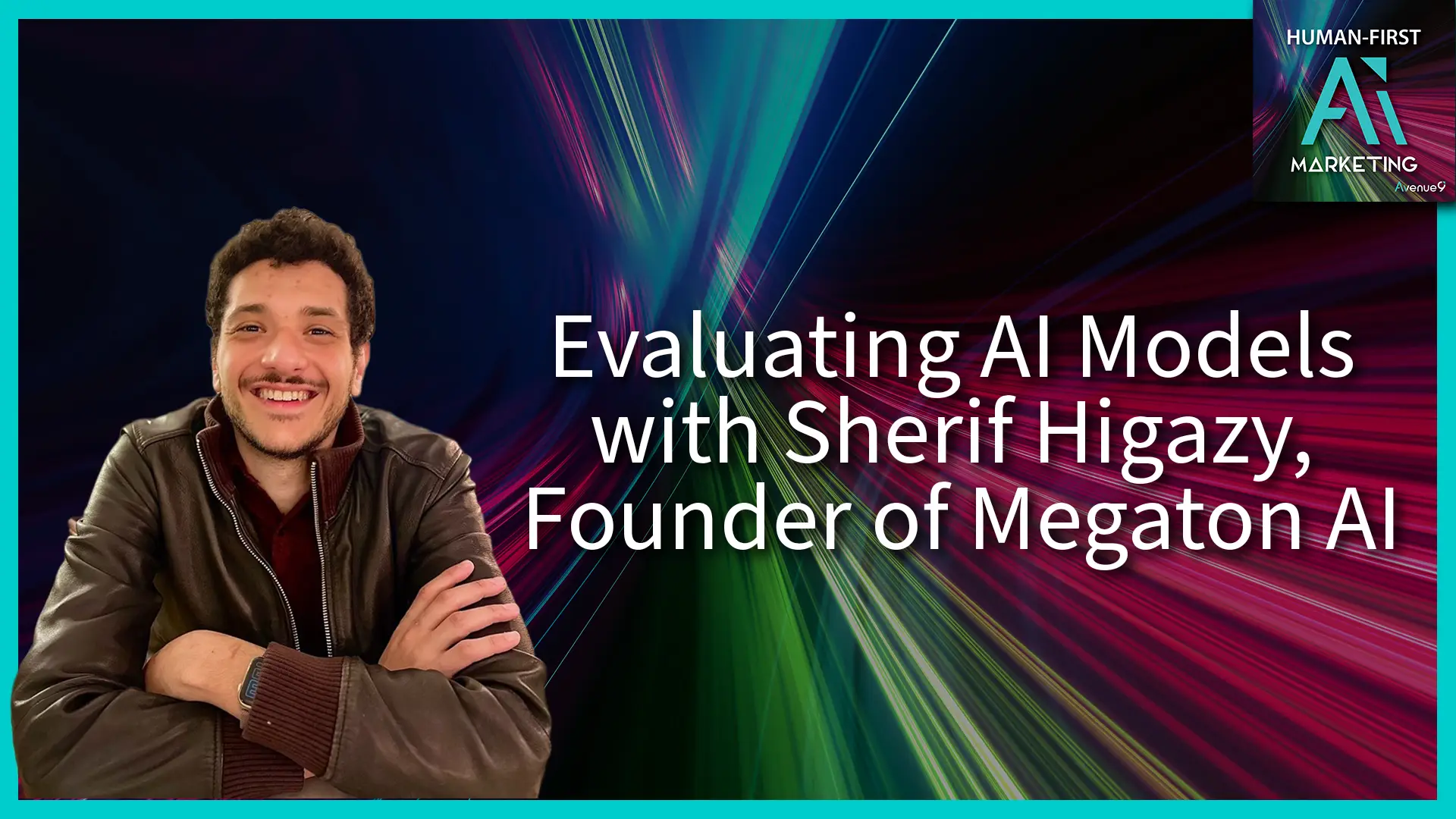
AI models are changing so fast that even the people building businesses around them have to work hard to keep up. In my conversation with Sherif Higazy of Megaton AI, a benchmarking and advisory firm for generative media, we talked about evaluating AI models, creative video tools, the rise of AI-generated media, and the practical decisions small and mid-sized businesses need to make before jumping into the next shiny platform.
Sherif’s company evaluates creative AI models, especially video models, and publishes leaderboards to help people understand which tools are actually performing well. That matters because the AI market is noisy. Every week brings a new launch, a new demo, a new “best model ever,” and a new wave of LinkedIn posts from people who sound like they just discovered electricity.
For SMB leaders and marketing directors, the lesson is simple: you need a way to separate real capability from marketing hype.
AI tools are now powerful enough to help you create videos, training materials, animations, music clips, campaign assets, and visual concepts that were previously too expensive or too time-consuming. The opportunity is huge. The risk is that you create more stuff without creating more value.
That is where Human-First AI Marketing® comes in.
The Big Lesson: Better Tools Still Need Better Taste
Sherif made a point that every marketer should tape to their monitor: creative AI models are harder to evaluate than text-based models.
With a text model, you can ask it to summarize a document, write code, classify information, or answer a question. You can usually tell if it worked. With AI video, the evaluation gets squishier. Does it feel cinematic? Does the motion make sense? Does the character stay consistent? Does the output look intentional, or does it look like a robot made a perfume ad after watching three YouTube tutorials and a dream sequence?
Creative work requires judgment.
That is the part many businesses skip. They try a video model, type in “make me a 60-second commercial,” get something weird, and decide the whole category is useless. The better approach is to start smaller. Create short clips. Test scenes. Build workflows. Learn what each model handles well. Use AI like a production assistant with superpowers, then let a human with taste, strategy, and business context direct the work.
Sherif described these tools as an extension of the post-production and visual effects process. That is a helpful frame for marketers. AI video can help you extend what is already possible: polish footage, create supporting visuals, test concepts, animate ideas, and generate assets that would have required a bigger budget in the past.
AI Video Is Moving from Novelty to Real Marketing Tool
For a while, people dismissed AI video because of obvious flaws. The fingers were wrong. The faces melted. The famous Will Smith spaghetti demo became the unofficial mascot of “AI video is creepy.”
That era is fading quickly.
Sherif shared that some of the strongest AI video models are coming from Chinese labs, including ByteDance’s SeeDance 2.5, which he described as especially cinematic. He also talked about open-source and locally run models, which matter for companies with sensitive intellectual property or legal requirements that prevent them from uploading confidential material to cloud-based tools.
That last point is important for SMBs.
A lot of business owners hear “AI video” and think about flashy social content. The more strategic use cases may be inside the business:
- Training videos for employees, franchisees, dealers, or customers.
- Product explainers that make complex services easier to understand.
- Sales enablement clips that answer common buyer questions.
- Internal communications that are more engaging than another 900-word email.
- Visual concepts for campaigns before spending money on production.
- Short promotional assets for podcasts, webinars, events, and launches.
The practical takeaway: AI video can lower the cost of experimentation. You can now test ten creative directions before committing to one. That used to be big-brand behavior. Now smaller companies can play that game too, without needing a Hollywood budget or a cousin with a drone.
Beware the Attention Tax
Sherif also named one of the biggest risks in the AI content era: the attention tax.
When AI makes content easier to create, the internet fills up with more content. Some of it is useful. Plenty of it feels like digital packing peanuts.
The tax shows up when audiences have to sort through low-effort emails, generic videos, lifeless social posts, and automated “personalized” outreach that feels about as personal as a parking ticket.
For marketers, this creates a new responsibility. Every piece of content you publish spends a little bit of your audience’s attention. Spend it wisely.
AI can help you create more, but volume alone is a weak strategy. Strong marketing still needs a point of view, a clear audience, and a reason to exist. Sherif said he often filters out AI-generated content when it feels like no one spent time making it worth watching. That should make every marketer pause before publishing another “thought leadership” post that could have been written by a microwave.
The human-first lesson is this: authorship matters.
People want to feel that someone cared enough to think before creating. AI can help you move faster, organize ideas, and repurpose content across channels. The leader still needs to decide what matters, what is true, what is useful, and what deserves the audience’s time.
The Best Use Cases Start with Constraints
One of the best themes from the conversation was the idea that AI shines when you use it with clear boundaries.
Bad prompt: “Make me an amazing video for my company.”
Better prompt: “Create a 12-second animated explainer showing how a manufacturer can reduce downtime with predictive maintenance software. Make it simple, professional, and suitable for a LinkedIn post.”
Constraints create quality.
Sherif talked about strong use cases in animation, visual effects, training videos, commercials, music, and short creative assets. He also shared how AI music opened up a personal creative use case for him: making disco electronic Arabic music that he could not easily find elsewhere. That is one of the most interesting uses of generative AI. It can create niche, specific, unusual things that would otherwise be unavailable, expensive, or buried somewhere in a stock library from 2008.
For SMBs, that is the unlock.
AI helps you make the thing you always wanted to make someday.
Someday when you had more budget.
Someday when you had a video team.
Someday when you had time.
Someday when your marketing director cloned herself and taught the clone HubSpot.
Someday is getting cheaper.
Local Models and Privacy Will Matter More
Sherif also brought up an issue that many business owners overlook: where your data goes.
Some companies cannot use cloud-based AI tools for sensitive work. Their contracts, legal requirements, client agreements, or internal policies prevent them from uploading proprietary information into external platforms. For those businesses, local models and open-source options become more important.
This is especially relevant for manufacturers, professional services firms, financial companies, health-related businesses, franchises, and any company with private customer information or proprietary processes.
The question for leaders is practical: which work can safely happen in public AI tools, and which work needs stricter controls?
At Avenue9, this is why we like mapping work before choosing tools. Some tasks belong in lightweight AI tools. Some tasks require approved platforms, private environments, or human-only handling. The tool decision should follow the risk level, the strategic value, and the type of information involved.
World Models May Be the Next Creative Leap
Toward the end of the conversation, Sherif talked about world models. These tools can take an image or scene and begin turning it into an explorable environment. Think less “static picture” and more “walkable experience.”
Sherif compared the future to the Star Trek Holodeck, which feels pretty accurate. Imagine turning a product image into a 3D training environment, a historical photo into an immersive lesson, or a facility layout into a virtual sales experience.
For SMBs, the future may look like:
- Virtual showrooms for industrial products.
- Immersive training for franchise employees.
- Interactive customer onboarding.
- 3D product demos for complex offerings.
- Sales presentations that feel more like guided experiences.
This will take time. The early versions will be expensive, awkward, and occasionally hilarious in ways nobody intended. That is how most new mediums start. The smart move is to begin learning now, while the stakes are still low.
What SMB Leaders Should Do Next
Here is the practical playbook from this conversation:
- Create a simple AI model evaluation habit. Track which tools your team uses, what they are good at, what they cost, and where they fail.
- Start with one small video use case. Pick a training clip, podcast promo, product explainer, or sales enablement asset before attempting a full campaign.
- Protect your brand voice and your audience’s attention. Give every AI-generated asset a human review for clarity, usefulness, tone, and taste.
- Use AI to test creative options before spending production dollars. Generate concepts, storyboards, scripts, visuals, and sample clips so your final investment gets smarter.
- Separate low-risk experimentation from sensitive business work. Use stricter tools and processes for proprietary, customer, legal, or confidential information.
- Build workflows instead of chasing demos. The value comes from repeatable systems your team can use again and again.
The Avenue9 Takeaway
The future of AI marketing belongs to businesses that combine human judgment with AI leverage.
Sherif’s work at Megaton AI is a reminder that tools need evaluation. Models change. Pricing changes. Capabilities shift. The leaderboard moves. Your strategy should give you enough structure to adapt without rebuilding your marketing plan every time someone launches a new model with a dramatic product video and a suspiciously smooth voiceover.
For SMBs, AI is becoming a creative force multiplier. It can help you produce better training, stronger content, more useful sales assets, and more interesting customer experiences. The winning move is to keep humans in charge of the message, then let AI help with the making.
That is Human-First AI Marketing® in action.
At Avenue9, we help SMBs turn expertise into content, conversations, and clients by building AI-powered marketing systems that still sound like you. If you want to evaluate your AI tools, create better workflows, or build a content engine around your real voice and expertise, visit Avenue9.com and let’s build the next version of your marketing system.