Every business owner wants a better go-to-market strategy, fewer wasted leads, better sales conversations, and cleaner data. A team that knows who to call, what to say, and when to say it.
Sounds simple. Then the real world walks in wearing muddy boots.
Your CRM is messy. Your best salesperson keeps the real playbook in their head. Marketing is chasing clicks. Sales is chasing replies. Your buyers are doing most of their research before they ever talk to you. And now AI has entered the chat with 9,000 tools promising to fix everything by Tuesday.
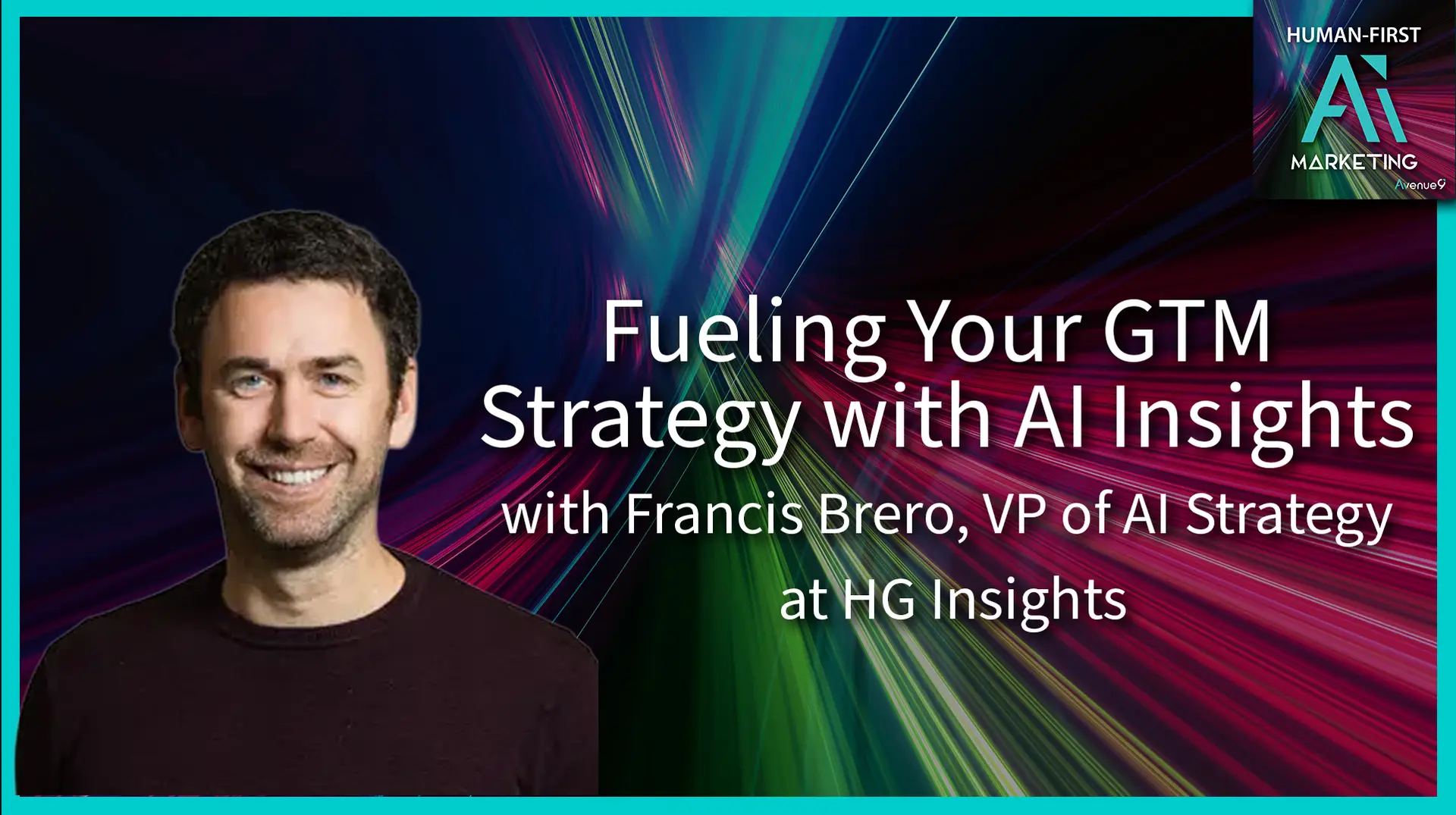
In my conversation with Francis Brero of HG Insights, we talked about what AI can actually do for go-to-market teams. The lesson was refreshingly practical: AI works best when it helps humans prepare, prioritize, and personalize with relevance. The revenue engine still needs a human driver, but AI can make the dashboard a whole lot smarter.
We break down how SMBs can use AI to help sales and marketing work smarter, together.
1. B2B Selling Is Really Organization Selling
Francis started with a point every SMB leader should write on a sticky note and slap on their CRM: in B2B, you sell to organizations through individuals. Your buyer might be one person on the Zoom call, but the decision usually involves a committee, a CFO, a technical evaluator, a compliance person, a legal reviewer, and someone quietly wondering if this project will make their life harder.
This matters because many sales and marketing systems still act like one lead equals one buyer. That creates shallow personalization and awkward follow-up. “Hey, Sarah, saw you went to Ohio State” is personalization. “Your team may be under pressure to consolidate software spend because three departments are using overlapping tools” is relevance.
Relevance creates better conversations. It helps your sales team enter the room with a useful point of view. It helps marketing create content that supports the full buying committee. It helps your champion explain your value internally when you are out of the room.
For SMBs, this is where AI can provide leverage. Use it to map likely buying roles, summarize account research, identify public signals, and prepare sellers with sharper questions. Treat AI like the instrument panel in your revenue engine. It should show the driver what is happening so they can make better decisions.
2. Capture the Playbook Hiding in Your Best Sellers’ Heads
One of Francis’s strongest points was that your best sellers often carry valuable process knowledge around in their own brains. They know where to research, which signals matter, which objections are real, and how to frame a conversation so buyers feel understood. That knowledge becomes a liability when it only lives with one person. If that seller leaves, the playbook leaves with them.
AI gives SMBs a way to turn that hidden expertise into a shared asset.
This is a huge opportunity for smaller companies because most SMBs cannot afford bloated enablement departments, enterprise training platforms, and 47-person revenue operations teams. They need a lightweight way to find what works and make it repeatable.
Start with the simple stuff:
- Record and transcribe sales calls with permission.
- Interview your top salespeople about how they prepare.
- Ask what buying signals they look for before outreach.
- Document the best discovery questions.
- Capture stories that help buyers understand the cost of inaction.
- Build a shared library of strong emails, talk tracks, objections, and follow-up language.
Then use AI to organize it, summarize patterns, and turn it into usable tools. That might include pre-call planning templates, account research briefs, CRM prompts, sales enablement sheets, or campaign ideas.
This is the Human-First AI Marketing® move: collect the human wisdom first, then use AI to make it easier for the whole team to use.
3. Break Big Problems Into Smaller Jobs
Francis shared a simple mental model I loved: break work into “atomic tasks,” then ask what you would pay a human to do each task. Some tasks are worth $5. Some are worth $5,000.
The $5 tasks are perfect for AI. Summarizing a LinkedIn profile. Pulling company details. Cleaning CRM fields. Drafting a first-pass meeting recap. Classifying emails. Finding repeated themes in call transcripts.
The $5,000 tasks require human judgment. Choosing the strategy for a major account. Deciding which relationship matters most. Reading the politics of a buying committee. Making the final call on positioning. Knowing when a deal needs patience, pressure, or a graceful exit.
This is where many businesses get sideways with AI. They hand the steering wheel to the software before they know where they are going. Then they wonder why the output feels generic, noisy, or a little suspicious. Hello, work slop. Population: everybody’s inbox.
For SMB leaders, the lesson is simple: make a task map before you buy another tool.
Create four columns:
- Task
- Human judgement required
- AI assistance possible
- Quality standard
You will quickly see where AI can save time and where your team needs to stay close to the decision. This keeps AI from becoming a shiny distraction and turns it into a practical operating system for sales and marketing.
4. Buyer Experience Beats Internal Efficiency
A lot of AI sales tools are designed around one question: “How can we reduce the cost of selling?”
That is a fair business question. It is also incomplete.
Francis made the point that buyers want a better experience. If someone agrees to a video call, they usually want a prepared human being with an informed perspective. They want to feel seen, heard, and understood. They want a seller who did the work before showing up. This is where SMBs can beat larger competitors.
Big companies often over-automate because they are trying to squeeze efficiency from a giant machine. Smaller companies can use AI to create preparation, speed, and consistency while keeping the interaction personal.
A good AI-assisted seller can walk into a call with:
- A summary of the prospect’s business.
- A likely buying committee map.
- Recent company changes or signals.
- Relevant industry pressures.
- Smart discovery questions.
- A clear hypothesis about the buyer’s problem.
That seller still needs to listen. They still need empathy. They still need business judgment. AI helps them arrive prepared, like Iron Man stepping into the suit. Tony Stark still makes the calls. JARVIS makes him faster, sharper, and harder to surprise.
5. Better CRM Data Can Reveal the Real Story
Francis also shared a great point about attribution. Digital reports often make it look like a lead came from organic search, paid ads, or last-click activity. Then a salesperson asks, “How did you hear about us?” and the real answer is a partner referral, a conversation, a podcast, or a colleague recommendation.
That is gold hiding in plain sight.
AI can help extract those insights from call recordings, transcripts, notes, emails, and CRM updates. This matters because your marketing strategy should be shaped by what actually creates trust, demand, and sales conversations.
For SMBs, this can change budget decisions fast. You might discover your “best channel” is really the place buyers go after they already trust you. You might find that partnerships, podcasts, referrals, events, or thought leadership are creating the spark, while search and ads are just catching the smoke.
That insight helps you invest with more confidence.
6. AI Notes Need a Human Last Mile
AI meeting summaries are useful. They are also getting a little ridiculous.
Francis pointed out that AI note-takers often capture everything and still miss the thing that matters. They create long summaries, giant action-item lists, and more digital confetti for people to sweep up later. The missing step is asking the human, “What actually matters from this conversation?”
That is the last mile. The transcript is raw material. The human takeaway is strategy.
A better meeting workflow looks like this:
- Record and transcribe the meeting.
- Let AI summarize the discussion.
- Ask the human owner to identify the one to three decisions, risks, or next steps that matter.
- Use AI to update the CRM, draft the follow-up, and pull relevant quotes or themes.
- Keep the human in charge of meaning.
This is especially important for marketing. A customer call might contain five seconds of language that becomes your next great campaign. AI can find the moment faster, but a human needs to know why it matters.
7. Voice AI Can Give Leaders Their Thinking Time Back
One of the more interesting parts of the conversation was Francis’s use of voice AI while walking. He described using an AI assistant to process email, think through replies, and regain some playful time away from the computer.
That may sound like a small workflow tip, but it points to a bigger shift.
AI can change the user experience of work. It can move us away from staring at screens all day and toward more natural ways of thinking, speaking, and deciding. For busy SMB owners and marketing directors, that is a big deal.
Some of your best thinking happens when you are walking, driving, cooking, or staring into space pretending to be productive. Voice AI can help capture that thinking before it disappears into the same place as your missing coffee mug.
Use it to talk through a sales follow-up, campaign ideas, customer stories or even a founder POV post. Then turn the transcript into something useful. This is how AI becomes a thought partner instead of another tab in your already overcrowded browser.
Use AI to Make the Human Moment Better
The throughline from Francis was that AI can help GTM teams research faster, prepare better, clean data, capture playbooks, summarize conversations, and identify patterns. The best use cases improve the quality of human interaction.
That is where Human-First AI Marketing® shines.
Your business already has valuable raw material: sales calls, customer questions, founder stories, service tickets, partner conversations, objections, wins, and lessons learned the hard way. AI can help turn that material into a smarter GTM system.
The goal is a revenue engine where:
- Marketing builds awareness and trust.
- Sales shows up prepared and relevant.
- AI handles the repetitive research and organization.
- Humans own the judgment, relationships, and strategy.
- Buyers feel understood before they feel sold to.
That is the kind of AI-powered GTM strategy SMBs can actually use. No robot sales army required. No creepy pink pony personalization. No 87-slide report nobody reads.
Just sharper insights, better conversations, and a more trustworthy path to revenue.
Ready to Build Your Human-First GTM Engine?
At Avenue9, we help SMBs turn their expertise, customer conversations, and sales insights into marketing systems that scale. Our A9^Factor Framework™ helps you clarify your audience, codify your brand voice, build smarter content systems, and use AI to amplify the human parts of your business that buyers already trust.
If your team is experimenting with AI but struggling to turn it into real sales and marketing momentum, let’s talk. We can help you build a Human-First AI Marketing® system that gives your team better fuel, a smarter dashboard, and a revenue engine that runs without burning bridges or blowing out the budget.